Cusco Tour

 Julia and I generally do not sign up for tours, preferring to look things over on our own.  In fact, on the day before our guided tour, we went to the market on our own and and enjoyed that experience.  


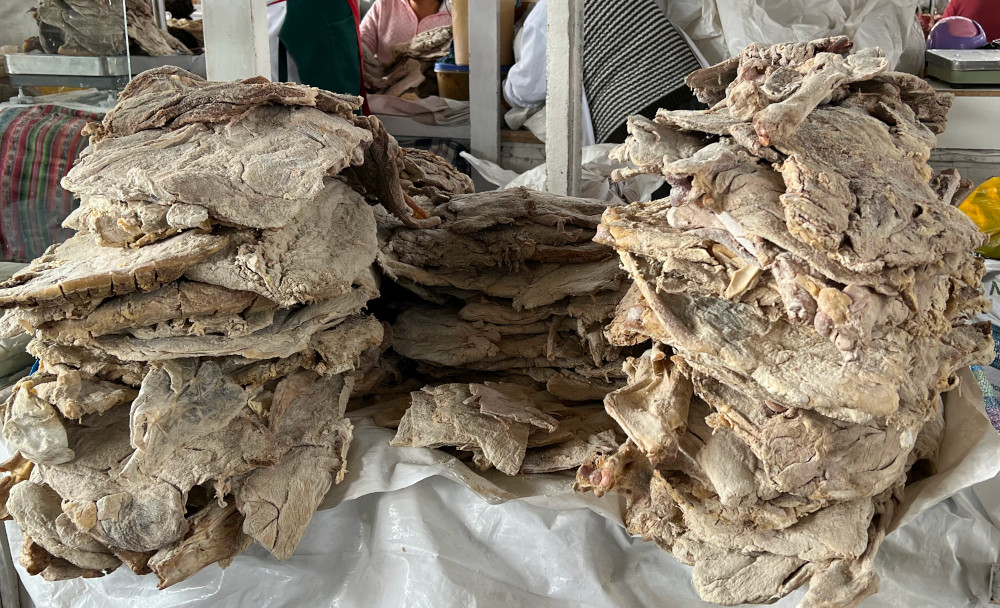
But when you are in a foreign land, there are some questions that you just can't answer without the help of a local.  Like what the heck is that?
As I mentioned before, one doesn't hike the Inca Trail solo.  The Peruvian government requires that foreigners be escorted by a licensed guide, who is almost always employed by the tour companies.  We chose our tour company because they received excellent TripAdvisor reviews and also are known for smaller groups.  We expected our trekking group to be about 8-12 people.  When our guide showed up at our hotel, we learned that our group was four people, and the other two people were working out some travel issues.  As a result, we would be receiving a private tour.

Freddy turned out to be a great tour guide: down-to-earth, low key, relaxed, and not afraid to express his personal opinion or to ask yours.  

That gray stuff in the pic up above taken from the public market?  Julia and I speculated that it was some kind of weird seafood.  Nope, Freddy said, it's yerky.  Julia and I looked at each other before it clicked:  jerky.  In Peru, meat is heavily salted for preservation.  After it's salted and dried, and salted and dried, and salted and dried, that's what Peruvian jerky looks like.  It did not look like something that I wanted to put in my mouth.

During the first part of the tour, Freddy took us up into the hillside to the ruins near Cristo Blanco.  While we learned a lot about the Inca culture, Freddie was blunt about the fact that so much is still unknown.  The stones used to build the temples and government buildings were moved long distances and up steep mountainsides.  The Inca had no horses or oxen.  There were no steel tools for cutting or shaping stone.  

Experts today can only hypothesize how the materials for construction were transported and then used at the building sites.  And the hypotheses keep changing as more ruins are uncovered and analyzed. 


Sacrifice Altar for people and animals

Window to a window to a window

Why can't we look back at the Inca written history to answer some of these questions?  Because there isn't any.  The Inca depended upon an oral history.

When the Spanish arrived during the 1500's, they killed off all of the leaders and educated people among the Inca.  The Spanish also destroyed many temples.  As a result, their history was mostly lost.  The Spanish didn't care much about learning the Inca construction techniques, but they were seriously focused about learning where the hidden Inca gold was.  As it turns out, there is very little gold or silver in the Cusco area.  The precious metals mined from other places in Peru were carefully hidden away  in the jungle--and only the elite knew the hiding places. 

When the Spanish demanded to know where the gold was, the remaining Inca honestly answered that all of the people who had the answers were dead.  To this day, treasure hunters are still trying to find the Inca gold.

Until we talked to Freddy, we had admired dozens of large Spanish churches.  Freddy told us that the Spanish destroyed the Inca temples in Cusco,  and replaced them with Catholic churches on the same sites.  Somehow, the cathedrals didn't seem quite as beautiful with that knowledge.

Freddy left us around noon, letting us know for the first time that he would be our Inca Trail guide also.  We would meet that night with our fellow trekkers and for our orientation. 


Peruvian Dining

The place that we heard and read about was called Chicha.  One doesn't get a table for dinner there without reservations.   And there were simply no reservations available before our Inca Trail hike, unless we were willing to eat at 9:30 p.m.  I'm not one for eating a meal right before bedtime.

Instead, we ended up at a place called Morena Peruvian kitchen which overlooked the Plaza de Armas. Peru is well-known for delicious food, and this was probably the best dining experience that we've had in many years anywhere for less than the price of Olive Garden in the U.S.

It started with a Pisco Sour.  Pisco is a grape distilled spirit.  The cocktail is generally made with Pisco, lime juice, egg white, and bitters.  Mine had some other fresh juices in it and was made table-side--something new to me.


Julia and I shared an appetizer:  grilled alpaca on a skewer, along with  potatoes and vegetables.  Peru has over 200 varieties of potatoes. 

Yes, the flowers are edible

Julia had a non-alcoholic drink made from purple corn and a chicken dish.

I had what they called beef stir-fry, but that doesn't do it justice. The marinated beef was flavorful and so tender that you could cut it with a fork.


Next up:  our guided tour of Cusco's public market and historical sites.


Summer has moved to October

After about a week of lighting up my fireplace insert to keep warm in the house, summer came back with 80 degree temperatures over the weekend.  

Justin is all moved into his apartment.  In fact, he is so moved in that he almost never leaves.  Justin has a very narrow temperature range of comfort.  Above 80, and he's too hot.  Below 65, and he's too cold.  So when he called me up and asked me to take him to the Madison Farmer's Market today, I was glad to oblige.  

Justin lives only a couple of miles from the state capitol where the market takes place.  So he rolled out the front door, and I got some additional steps in after my early morning walk with Callie. Justin's chair is rated for 8 miles without a charge, but the battery is reaching the end of its life so we kept an eye on the battery.  Before we finished, we picked up some buffalo beef jerky for Justin and a big bag of Thai chili peppers for me.  

Justin wanted to watch the Wisconsin Purdue game in his apartment, so we parted ways.  I went over to the patio of Working Draft Beer Company and sipped on "Dad Bod" Stout, which Bill from Nebraska would have loved.  A simple oatmeal stout with chocolate malt (dark roasted barley).  Simple, full-bodied, flavorful and not too much alcohol.


Julia has been visiting our daughter Allie in California.  She should be returning home on Tuesday.  I better get the house cleaned up.

Peruvian Chocolate Factory

Long time readers will recall that Julia and I took a tour of a chocolate factory in Belize in 2019. It isn't a coincidence that we toured one in Peru.  First, I love chocolate.  Second, there is a roasting process for cocoa beans (technically, cacoa seeds) that is somewhat similar to the roasting process for coffee.

When I roasted coffee commercially, I was approached by an investor in a Hawaii chocolate operation  He wondered if there might be a way for me to roast cocoa beans in my Lodi shop. Meh, it wouldn't really be practical.  The temperatures are much lower for roasting.  And coffee beans and cacoa seeds don't mix very well on the same roasting machine in terms of odors and the clean-up.

But I'm still very interested in the process.  The chocolate factory was around the corner from our hotel and offered a free self-tour.  We feasted our eyes on the process but didn't buy anything here due to the "special" gringo prices.  We later bought chocolate at the general market (more on that later).

Cacao Seeds and Sugar


This photograph shows the seed grinder and the mixers for the cacao and sugar.  Factory workers are shaping and packaging.

Roaster is upper right

 
Final product

Sunday Morning Coming Down

When Julia and I came down the steep stairs from Cristo Blanco, we were greeted by all kinds of festivities in the Plaza de Armas, which take place every Sunday morning.

Girls Middle School Band


The photo above shows both the adult band and the local officials under the red tent presiding over the flag ceremony.  On every Sunday morning, hundreds of local people in Cusco come to the plaza to watch the raising of the Peruvian flag and the flag of Cusco.  Patriotic songs are sung to cheers.  The flag ceremony takes well over an hour, including speeches.  All of that time the flag raisers must stand at attention.

Elections were to take place the following Sunday.  In Peru, voting is mandatory.  There are no alcohol sales on the day preceding the election, the day of the election, or the day after the election.  Voter id cards are required.  There are stiff fines for not voting.  Because so many people had their voter id card expire during the pandemic, there were long lines of people wearing masks to enter buildings in order to renew their voting cards during the week before the election.  The reason that elections take place on Sundays is because that is the day off for family.  Work is not an excuse.  If one is required to work on Sunday, employers are required to let employees have time off to vote.  

Food for thought. 


Cristo Blanco

 From Sept 25th, 2022

We were both feeling pretty good when we went to bed on the previous night.  However, morning came at 4 a.m when the hotel kitchen staff started getting ready for breakfast, which is available from 4:30 a.m. until 11 a.m.  Our room was across a small courtyard from the kitchen, but we made the mistake of leaving our windows open.  

After breakfast and coca tea, we left the hotel  at 7:30 a.m. for our self-directed hike to Cristo Blanco, the most famous monument in Cusco.  Make no mistake about it:  this was not a nature hike.  We would walk on pavement across the city, past the tourist areas, and up into the mountainside where working class Cusco lives.

The Spaniards built cathedrals everywhere in Cusco, so I guess it's no surprise that a huge white Jesus overlooks the city.  There were some other interesting sites along the way.


We were so focused on getting to the top of the mountain that we took a wrong turn into some ruins.  


A very upset parks employee came up to us and demanded that we buy $40 tickets to keep looking at the ruins.  When we asked where Cristo Blanco was, she gave us a disgusted look and pointed to where we had missed our turn.  I think she said "gringos" under her breath but it could have been something more colorful.


I can't say that I was impressed with the 26' tall White Jesus, but I liked his view.


We took a different way back down.  I don't think Julia liked these steps.


But she made it without blowing out a knee. We survived our first steep hike above 11,000' and experienced some  breathlessness but no other side affects. We didn't know at the time that these stairs were a very good introduction for the Inca Trail later that week.

It was only 9 on a Sunday morning.  The city was just beginning to wake up. More on that in the next post.


Camping with Elon?

 This interesting rig was in our campground last night. The trailer appears to be a prototype from a California start-up company.