Seward, Alaska: Boat Trip


On our last day in Seward and the day before we flew home, there was one more item on Julia’s “to-do” list that needed checking off.  Before we left Alaska, it was important to go out on a boat and see the glaciers and sea life.

Now, while Julia grew up in a fishing family and around boats, I barely know how to swim and have already been seasick several times when out on the Pacific or Gulf Coast.  I am not a boat/water person. Then there was the matter of cost.  An all-day ride was over $200/person.  Marriage is about compromise, however, and we were on our 30th anniversary celebration trip, so we were going on a boat ride.


Partly because of low expectations, I was pleasantly surprised by our boat experience.  We left on a gray, drizzly morning.  Staff warned us to take medication if we were at all susceptible to seasickness, because seven-foot waves were expected in the Gulf of Alaska, which we would be crossing.  The boat seemed big enough that I wasn’t too worried.  During previous bouts of being seasick, I was either on a smaller boat and/or had possibly too much fun on the night before going out to sea.

There were a handful of people on our boat who were unpleasantly surprised.  I would guess about a half-dozen passengers spent most of the trip hanging over the back railing and filling up paper bags, as the boat rolled up and down through the waves. One elderly woman spent the entire trip throwing up or laying down in a dead-like position. She paid big bucks to be absolutely miserable for six hours.

We started the trip sitting at the rear of the boat, but as people succumbed to the rolling motion, we quickly moved to either the top or front deck, depending on the best vantage points.  We had assigned seating inside the cabin, and we spent some time talking with  our table-mates.  It was harder to see inside though, and the fresh outside air helped me from joining the sick folks on the back railing, so we spent most of the trip outside.

Within the first hour, we saw a pod of killer whales (orcas).


We drifted with the pod for about 30 minutes and watched these magnificent creatures surfacing  and blowing.  It was an unexpected sighting, staff told us, because these killer whales were passing through on a late migration.  While this wildlife sighting was our most memorable, we also saw sea lions, seals, dolphins, rare birds and mountain goats.  Due to the limitations of my phone camera, I cannot share most of these sightings with you, but I have a small sample.  If you click and enlarge, you can see the sea lions in the lower portion of first photo and mountain goats at the top of the second photo.


If someone asked me what my favorite part of Alaska was, it would be the glaciers.  The views from the boat were amazing, and we spent about an hour by the glacier.


As I watched the glacier calve (the breaking away of icebergs into the water), it occurred to me that future generations may not be able to see glaciers.  It’s natural for glaciers to retreat/melt in the summer and build back up in the winter. It’s natural for ice ages to come and go. However, the rapid retreat of glaciers today is not normal.  No matter what your politics, it would be a rare person to view a glacier, see photographic evidence of how fast they are disappearing, and not wonder what the world will be like for future generations.

I don’t have any answers.  Even if human beings are totally responsible for today’s climate changes, it seems unlikely to me there’s enough political will to have a snowball chances in hell to reverse those changes, even if we could.  One thing is for sure: nature is one powerful force to reckon with.

Kenai Fjords National Park


During our stay in Seward, Alaska, we drove one morning to the Kenai Fjords National Park to hike up to Exit Glacier.  The Visitors’ Center opens at 9 a.m., and the parking lot is often filled by late morning, so we were there at 9 sharp.

As we walked up to the building, someone shouted out to us that the 3 1/2 hour guided tour on the Harding Icefield Trail had just left and we could probably catch up if we hurried. Julia and I jogged quickly up the trail and asked permission to join the group, which consisted of the ranger and a father/son.  The ranger agreed and then talked for about five minutes about bear safety on the trail.

“I’m not trying to scare you, but this is bear country, and I want you to prepared,” he said, letting us know that he had bear spray, but we should holster up with our own if we had some (I did).  It turned out that this ranger usually did boat tours and that this was only his second hike of the season on this trail. We quickly started our ascent through heavy forest and brush.  “There are bears all around us,” he said, “but they generally keep away from people.”

We learned that he was not going to take us on the entire trail, but was only going to go far enough that we would be able to get a good view of the glacier. On the way, he instructed us on all types of trees and plants, including several very toxic ones.  It was very informative, and we were glad for the guided hike, even though the group went slower than our usual pace.


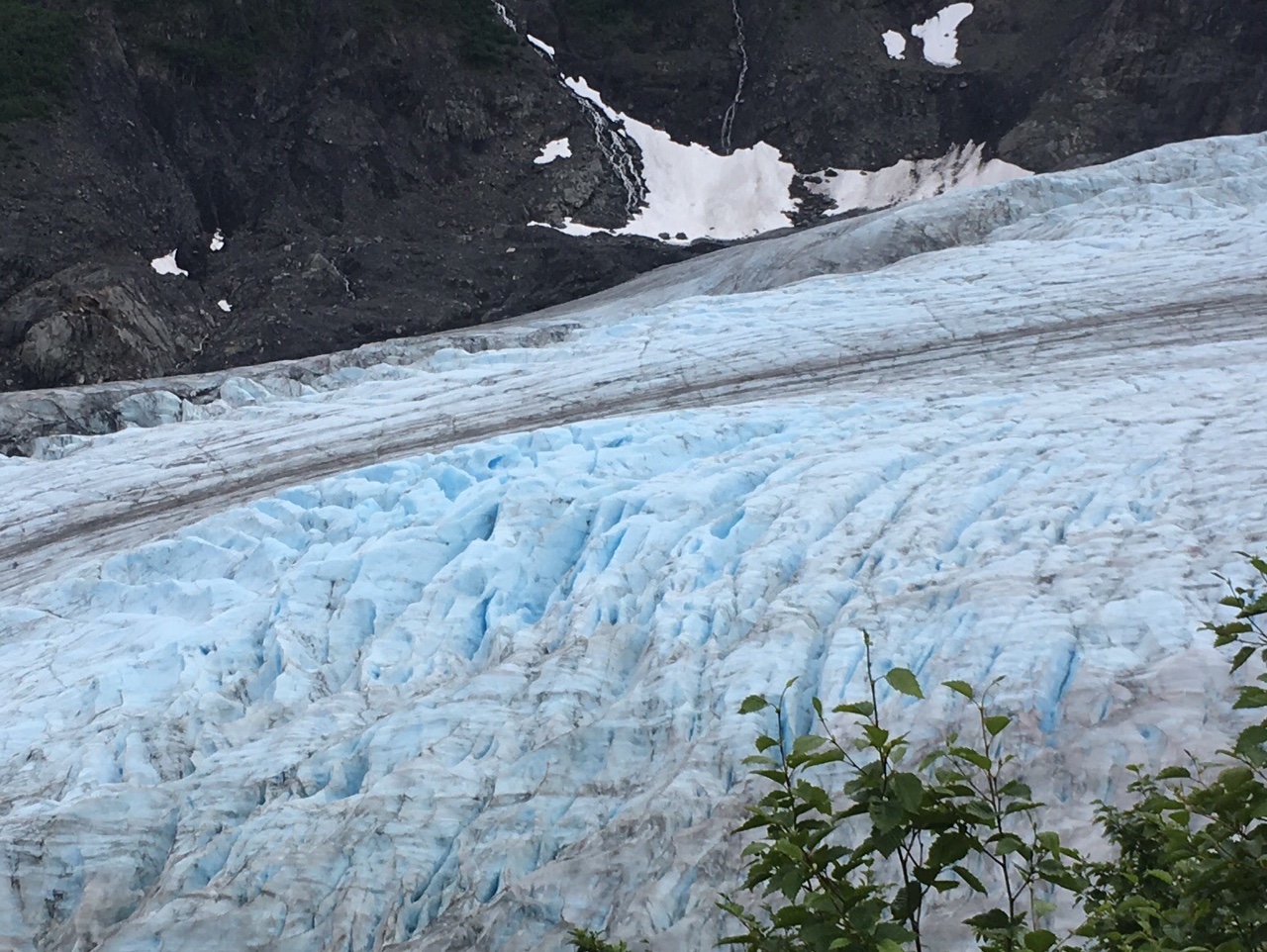
At first glance, the glacier looks like a long, steep saucer or sled hill.  But upon further review, it contains crevasses that would easily swallow a person or even a house.


At the meadow overlooking the glacier, we parted ways with our ranger and continued up the Harding Icefield trail on our own.  The trail climbed more steeply above the top of the glacier so that we could see the beginning of the Ice Field from the High Cliffs segment of the trail. In the photo below, you can see a mountain rising up in the distance within the icefield.  That mountain was only briefly visible before fast-moving clouds buried it in the mist. The ice field extends back 3 miles from the top of the glacier.


Just after the above photo was taken for us, another couple shouted out to us in excitement and pointed to a patch of alpine cover next to the ice.  It was too far away to show up in our photo, but this was our first and only black bear sighting in Alaska.  I thought the bear was pretty far away, but the local woman taking the photo told us that the bear was actually pretty close as far as sightings go.  “They are all around us in the park,” she said, “but you don’t usually see them until you get above treeline and have this type of view.”

Within a minute the bear ran off in the opposite direction and dropped below our view entirely.

Fortunately, this was not our only wildlife sighting on this trail.  On the way back down, we encountered the wild and dangerous Alaskan marmot.


This guy was very ticked off that we wanted to pass him, and he basically refused to move until I was just a few feet away, and even then I had to cough to get him to move off of his perch.  I later learned upon doing some research that he was likely a lookout for a whole family of marmots. I’m glad our close encounter was with the marmot instead of the bear.

We thoroughly enjoyed this hike, which was about 7 miles including our side trails.  We did not walk to the end of the Ice Field Trail, after receiving a warning of a grizzly with two cubs on the trail above the cliffs’ overlook.  The entire trail is 8.2 miles.

Seward, Alaska


After a couple of rainy, misty, cool, cloudy days in Seward, we asked a coffee shop barista if this was typical Seward summer weather? “Yep,” he replied. “This is kinda Seward’s vibe.”


So we put on our fleece sweaters and rain gear to stay outside and deal with Seward’s vibe. With about 2300 residents, Seward is a small tourist town and expensive. Our room here was the most costly of our stay. While clean, our 8’x 10′ basement room with no closet and a tiny bathroom was not someplace we wanted to spend much time in.

As a result, we did a lot of walking in the rain along the shoreline, port and downtown. Seward is another Alaskan town with prominent murals. Since it marks the start of the Iditarod, much of the public art focuses upon that famous dog race.


In between the port and downtown, there is over a mile of municipal campground with just about every type of rv rig you can imagine from Casitas to expedition vehicles to huge motor homes. Fees ranged from $40 for hookups to $20 for dry camping to $10 for tenting.  There were about a dozen hardy tenters each day we walked by.

Seward had one brewpub: Seward Brewing. We visited a couple of times. The beer was good, especially the imperial stout, which they ran out of on our last night there. Also, there was some interesting metal art and a painted concrete bar.


That last photo wasn’t at the brewpub but I felt compelled to add it in.
We dined at two excellent restaurants: Chinooks and Ray’s, Both had great food, drinks and views.


Kachemak Bay State Park


After a couple of days of walking up and down Homer Spit’s shoreline, we were ready to do some hiking again. Our Homer hosts recommended visiting the state park across the bay. The only problem is that you can’t drive there; the only way to get there is by boat. So we took our first water taxi to Kachemak State Park.


Our “driver”/captain took us on a bumpy thirty minute ride across the bay.  Just before dropping us off on a gravel beach, sea otters were spotted.


We were scheduled to be picked up by a different water taxi five hours later.
Armed with our bear bells and my bear spray, we started off into the dense, wet forest. The Glacier Spit trail was actually very well-constructed , and for the first couple of miles, we followed a young couple who called out, “hey bear, yo bear,” every five seconds. Then we hiked a side trail to a hand tram that crossed a river gorge. This was my first experience with a hand tram, and I must say that Julia was very trusting.


I managed to get her back again, so we backtracked to the main trail and continued hiking. After another mile we saw several people standing close together off the trail in the brush and taking photos. As we approached, a young man told us that a black bear was ten feet off the trail just five seconds earlier. I looked to where he pointed, but the bear had clearly taken off and was no longer visible. Only slightly disappointed, we hiked on to our destination. Grewink Glacier Lake.

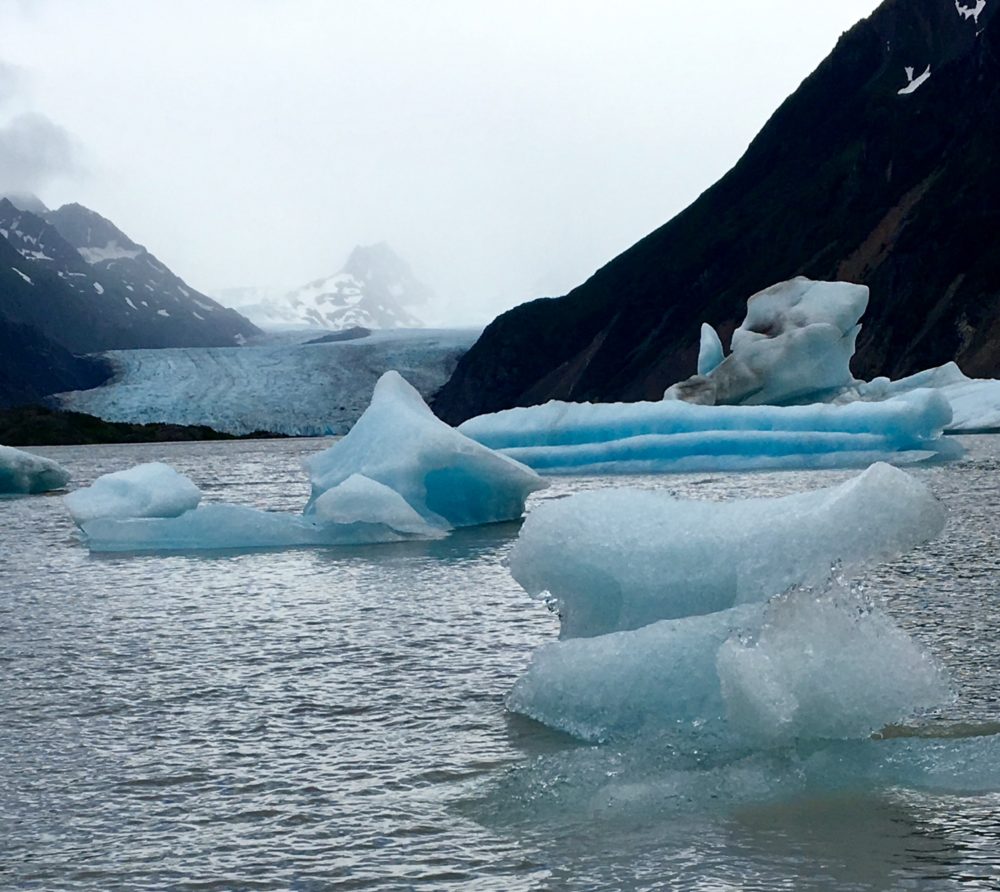
The lake and glacier were spectacular.


The photos don’t adequately capture the intense blue of the icebergs. I’ve never seen anything like it. Also, we experienced calving: when a big chunk breaks off an iceberg creating two icebergs. The sound when that happens is like an explosion and startling.

After spending over an hour at the lake, we hiked a couple more miles back to our pickup point at the Saddle Trailhead. We highly recommend hiking at this state park.


Homer: Fishing and Beer


There are numerous signs displayed around Homer, Alaska that say, “Homer: a quaint little drinking village with a fishing problem.”  Although I am not a fisherman, I can verify that fishing is taken very seriously here.


As for the drinking part, I can only testify that the local beer culture is alive and well. We visited two microbreweries:  Grace Ridge Brewing and Homer Brewing. Both were outstanding. Grace is owned by a San Diego couple who moved to Homer for employment. Upon retirement, they started a brewery (I am grateful, but that isn’t my idea of retirement).

Julia drank an IPA, and I had a delicious sour that was not overdone. Just enough sour to make it interesting.

On another day, we visited Homer Brewery. Julia had a Red Scotch Ale which was not too strong, and I went for the King and Wing ESB, cask conditioned and served by the beer engine. Easily in the top three beers I’ve  had in Alaska.


Girdwood, Alaska


After our train returned to Anchorage, we rented a car and drove to Girdwood. We rented a room called the Treehouse for two nights. Our first stop was Girdwood Brewing Company. I had a Northeastern style cloudy IPA, while Julia took the West Coast version. In the third photo below, I discuss with staff the pros and cons of high alcohol percentages in beers that taste really good.


After a light breakfast on the next morning, we drove to the trailhead to hike to the Byron Glacier. Although this is a popular easy hike, we arrived early enough that we pretty much had the area to ourselves for exploration and picture-taking.


I wasn’t sure that I even wanted to hike to a glacier, but I am so glad that we did.
After a short nap at the Treehouse, we ventured out mid-afternoon to hike the North Face trail at Mt. Alyeska. Many people pay to take the tram up and then hike down, but frugal John wanted to hike up and take the tram down for free.  With a vertical rise of over 2000 feet in 2.2 miles, we earned outstanding views, a beer at the top, and the free ride down.


Camping with Elon?

 This interesting rig was in our campground last night. The trailer appears to be a prototype from a California start-up company.