After a couple of rainy, misty, cool, cloudy days in Seward, we
asked a coffee shop barista if this was typical Seward summer weather?
“Yep,” he replied. “This is kinda Seward’s vibe.”
So we put on our fleece sweaters and rain gear to stay outside and
deal with Seward’s vibe. With about 2300 residents, Seward is a small
tourist town and expensive. Our room here was the most costly of our
stay. While clean, our 8’x 10′ basement room with no closet and a tiny
bathroom was not someplace we wanted to spend much time in.
As a result, we did a lot of walking in the rain along the shoreline,
port and downtown. Seward is another Alaskan town with prominent
murals. Since it marks the start of the Iditarod, much of the public art
focuses upon that famous dog race.
In between the port and downtown, there is over a mile of municipal
campground with just about every type of rv rig you can imagine from
Casitas to expedition vehicles to huge motor homes. Fees ranged from $40
for hookups to $20 for dry camping to $10 for tenting. There were
about a dozen hardy tenters each day we walked by.
Seward had one brewpub: Seward Brewing. We visited a couple of times.
The beer was good, especially the imperial stout, which they ran out of
on our last night there. Also, there was some interesting metal art and
a painted concrete bar.
That last photo wasn’t at the brewpub but I felt compelled to add it in.
We dined at two excellent restaurants: Chinooks and Ray’s, Both had great food, drinks and views.
After a couple of days of walking up and down Homer Spit’s
shoreline, we were ready to do some hiking again. Our Homer hosts
recommended visiting the state park across the bay. The only problem is
that you can’t drive there; the only way to get there is by boat. So we
took our first water taxi to Kachemak State Park.
Our “driver”/captain took us on a bumpy thirty minute ride across the
bay. Just before dropping us off on a gravel beach, sea otters were
spotted.
We were scheduled to be picked up by a different water taxi five hours later.
Armed with our bear bells and my bear spray, we started off into the
dense, wet forest. The Glacier Spit trail was actually very
well-constructed , and for the first couple of miles, we followed a
young couple who called out, “hey bear, yo bear,” every five seconds.
Then we hiked a side trail to a hand tram that crossed a river gorge.
This was my first experience with a hand tram, and I must say that Julia
was very trusting.
I managed to get her back again, so we backtracked to the main trail
and continued hiking. After another mile we saw several people standing
close together off the trail in the brush and taking photos. As we
approached, a young man told us that a black bear was ten feet off the
trail just five seconds earlier. I looked to where he pointed, but the
bear had clearly taken off and was no longer visible. Only slightly
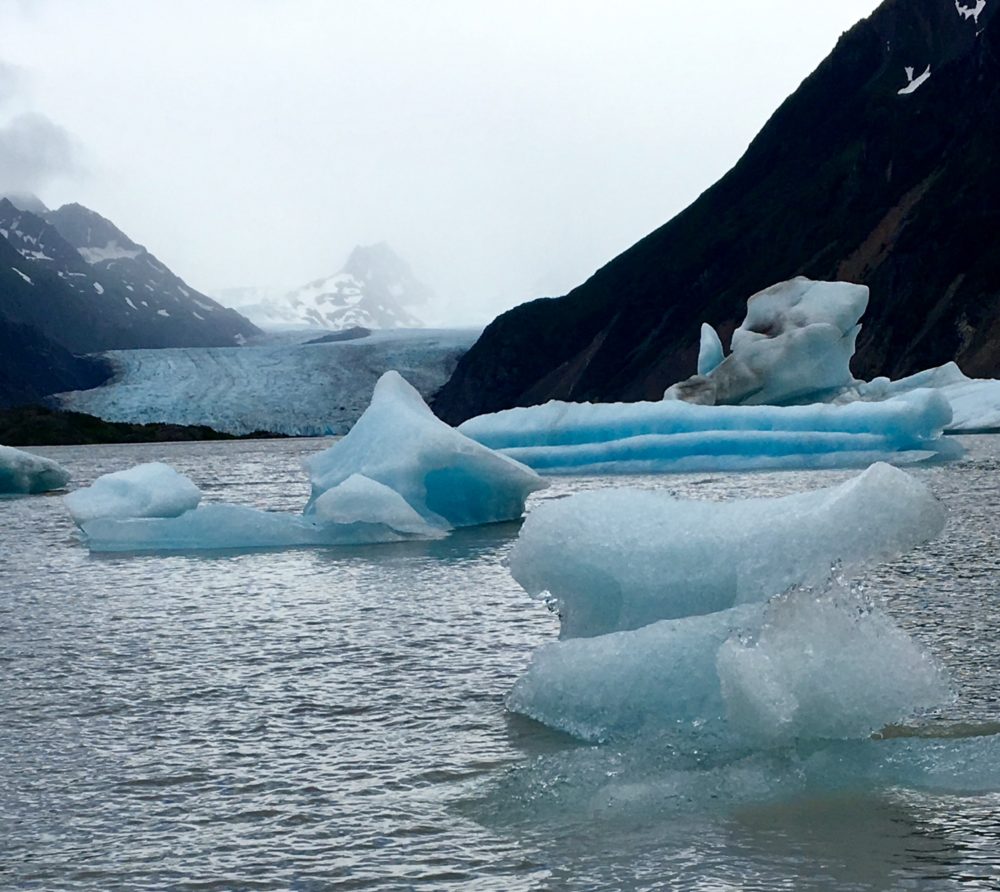
disappointed, we hiked on to our destination. Grewink Glacier Lake.
The lake and glacier were spectacular.
The photos don’t adequately capture the intense blue of the icebergs.
I’ve never seen anything like it. Also, we experienced calving: when a
big chunk breaks off an iceberg creating two icebergs. The sound when
that happens is like an explosion and startling.
After spending over an hour at the lake, we hiked a couple more miles
back to our pickup point at the Saddle Trailhead. We highly recommend
hiking at this state park.
There are numerous signs displayed around Homer, Alaska that say, “Homer: a quaint little drinking village with a fishing problem.” Although I am not a fisherman, I can verify that fishing is taken very seriously here.
As for the drinking part, I can only testify that the local beer
culture is alive and well. We visited two microbreweries: Grace Ridge
Brewing and Homer Brewing. Both were outstanding. Grace is owned by a
San Diego couple who moved to Homer for employment. Upon retirement,
they started a brewery (I am grateful, but that isn’t my idea of
retirement).
Julia drank an IPA, and I had a delicious sour that was not overdone. Just enough sour to make it interesting.
On another day, we visited Homer Brewery. Julia had a Red Scotch Ale
which was not too strong, and I went for the King and Wing ESB, cask
conditioned and served by the beer engine. Easily in the top three beers
I’ve had in Alaska.
After our train returned to Anchorage, we rented a car and drove to
Girdwood. We rented a room called the Treehouse for two nights. Our
first stop was Girdwood Brewing Company. I had a Northeastern style
cloudy IPA, while Julia took the West Coast version. In the third photo
below, I discuss with staff the pros and cons of high alcohol
percentages in beers that taste really good.
After a light breakfast on the next morning, we drove to the
trailhead to hike to the Byron Glacier. Although this is a popular easy
hike, we arrived early enough that we pretty much had the area to
ourselves for exploration and picture-taking.
I wasn’t sure that I even wanted to hike to a glacier, but I am so glad that we did.
After a short nap at the Treehouse, we ventured out mid-afternoon to
hike the North Face trail at Mt. Alyeska. Many people pay to take the
tram up and then hike down, but frugal John wanted to hike up and take
the tram down for free. With a vertical rise of over 2000 feet in 2.2
miles, we earned outstanding views, a beer at the top, and the free ride
down.
During our train journey and stay in the Mount Denali area, we made
every effort to see some real Alaska wildlife. If I had my druthers,
my preference would have been to see a brown or grizzly bear from a
considerable distance away. But I was up for seeing caribou, Dall
sheep or even moose at a closer distance.
On the train trip north and south, we pretty much saw nothing, except
for a brief glimpse of a moose butt. While in the Denali National Park
area, we even signed up for an expensive jeep excursion. We had a good
time driving our jeeps up and down gravel roads, but we again caught
only the glimpse of a distant moose before returning to the jeep parking
lot.
However, on the afternoon after the jeep ride, Julia and I asked to
get dropped off on our own at the Denali National Park Visitor’s Center.
We decided to hike the Horseshoe Lake loop trail, which was one of our
better decisions and totally free. We picked up our trail map and headed
outside where we met a delightful older gentleman and his golden
retriever. After some conversation, he offered to walk with us to the
trailhead. He explained that he lived in the area full time, that he was
retired and that his wife was director of operations at the national
park. He offered some great advice and told several stories.
One of the stories is that he had been attacked numerous times by
moose in the park. During the last attack, he ended up on the ground
with the moose kicking and stomping on him. He survived without serious
injuries but his dog sustained two skull fractures. He told us that if
we ever encounter moose up close to seek cover between trees and the
moose. The conventional wisdom to run away often doesn’t work.
With a new respect for moose, we parted ways and started down the
trail. Immediately, people coming up the trail told us to watch out for a
mama moose with a calf on the left side of the lake. We didn’t see that
moose but we watched another feeding in the lake. The moose dipped its
head under water for 20 to 30 seconds and emerged, chewing on underwater
vegetation. The moose stayed in basically the same feeding position as
we quietly looped around the lake.
We then ran into more people telling us that the mama and calf were
just ahead before the next bridge. We didn’t find the moose at that
location.but we did find their wet tracks.
Disappointed that we just missed the moose, we continued past the
bridge to the river, where Julia started taking scenery shots and video.
Meanwhile, I was bored and looked back up into the woods close the
where the moose had left the trail. At that instant, I saw the mama
moose and calf walking our way and directly toward where Julia was with
her back to the moose.
I started calling Julia softly at first and then with more enthusiasm
as she continued to ignore me and operate her camera.. “Mama moose,
now, time to go!” I suggested. We quietly but quickly moved away from
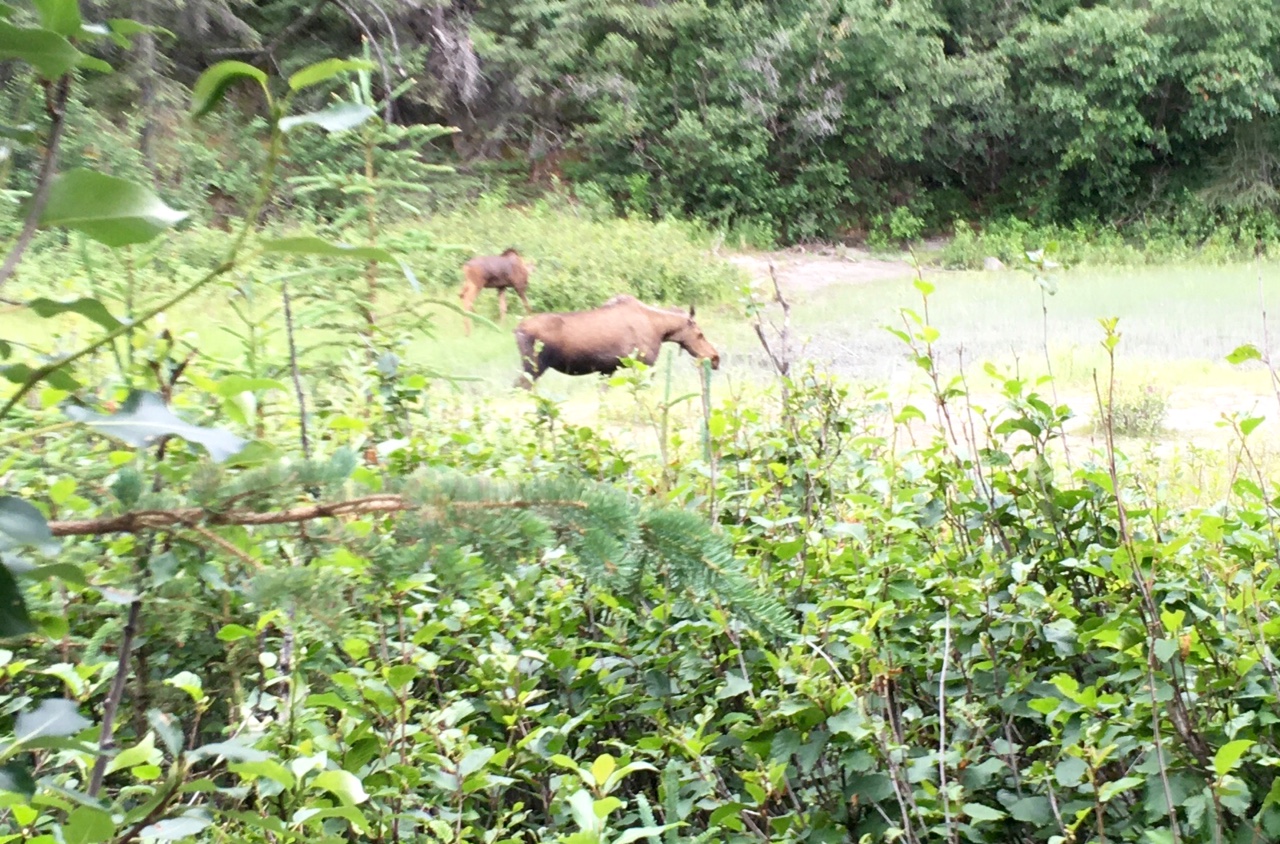
their path before we could be cut off from the trail. It was very
exciting, and we were able to take photos from behind the bushes once we
were out of harm’s way.
We finished up our hike with our hearts racing at this close encounter with mama moose and baby moose.
Mount Denali is the tallest mountain in North America and has the
largest vertical rise in the world. We did not hike the mountain. But we
did join the 30 Percent Club: visitors who actually get to see the
mountain as it is usually covered in clouds.
This was one our first views. We were excited to see the peak because
we talked to visitors from the week before who saw nothing but rain and
clouds.
We didn’t know that our first glimpse was just a tease of what was to
come. The weather on the mountain changes constantly but rarely
provides a full view.
We
felt so fortunate to take in Denali’s immense beauty. Expeditions to
climb the mountain take 3 weeks. Unfortunately, we only had two weeks.
Actually, climbing season is over for the year, and I lack both the
money and the skills to climb it. But it was fun to imagine doing so.