G5 Brewing Company


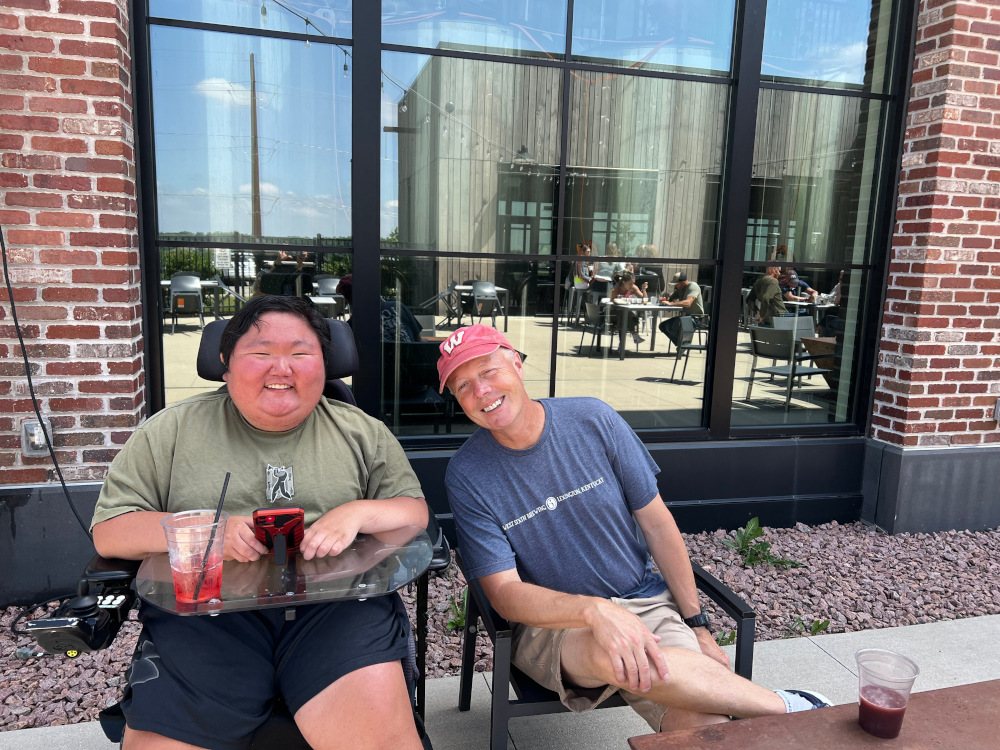
Yesterday, after the cancellation of the minor league baseball game, we headed for G5 Brewing Company, located near Beloit, Wisconsin. Founded in 2019, the modern building is nestled between an Amazon Fulfillment Center and other large industrial complexes.  

It was actually a nice space, indoors and outdoors.  I wasn't expecting much after reading the reviews.  But as sometimes happens, I was pleasantly surprised.  


A warm, sunny day--perfect for sour beer on the patio.  Yes, I said sour beer.  It seems that beer aficionados either love or hate sours.  For me, it depends on what I'm looking for.  The main criticism that I read about sours is they don't taste like what beer is supposed to taste like.  One of the things that I like about fermented substances in general is that there are a wide range of flavors and products.   I ordered a Bramble Brawl, a dark purple beer full of berries.  To me, it tasted like fermented fruit smoothie and weighed in at exactly 5% alcohol.  

A German law from 1516 says that beer must be brewed from only four ingredients:  water, hops, barley, and then yeast.  This beer broke the law but passed my taste test.

It's all good


A Minor League Kind of Day

Today, the plan was to pick up Justin in Whitewater and take him for an early Father's Day celebration at a minor league baseball game in Beloit, Wisconsin.  It was to be a battle of the Beloit Flying Carp vs. the Wisconsin Timber Rattlers. 

Two vehicles were going to be necessary because someone was going to have to pick up Allie from the Chicago airport, due to changes in her European travel itinerary.  Julia met us in Beloit at the City Hall parking lot, which is next door to ABC Building Supply Stadium. We arrived about 45 minutes before game time.  Julia was waiting with Mexican food, and we had a nice meal before we heading to the game.

Just as we started across the parking lot, two guys were walking to their car.  One guy said, "Were you folks planning on going to the game?" "Yup, we are," I responded.  "The game has been cancelled due to an outbreak of Covid" he replied.   "Hmm," I mused.  

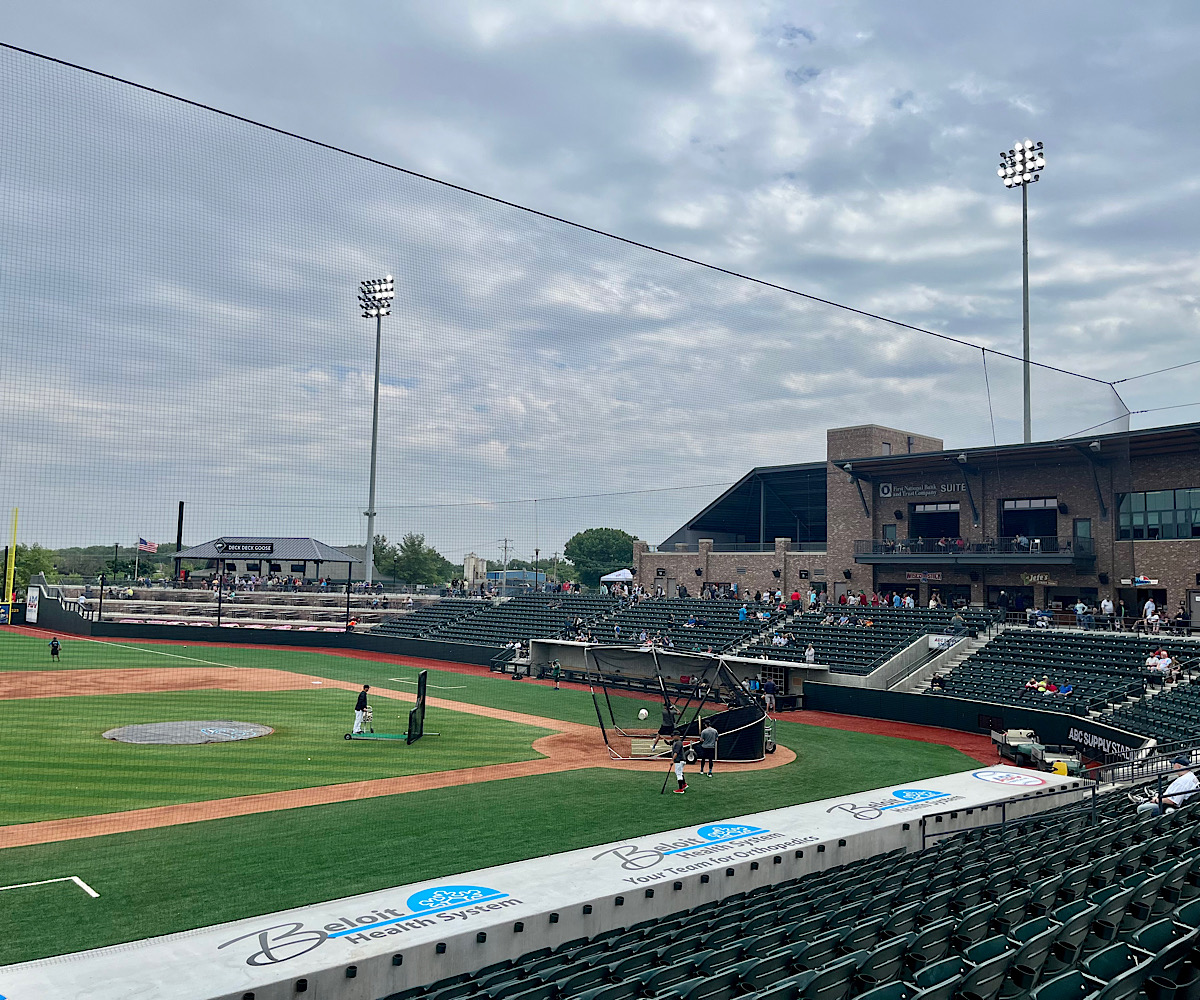
We walked over to the stadium to confirm, and sure enough, he was right.  No game, and lots of disappointed fans finding out at the last minute.  The gate attendant didn't know any of the details of the outbreak, but confirmed that there was no game.  Tickets could be exchanged for a future game, and we were invited to come into the stadium for a free 30 minute batting practice.  "Hmm,"  I mused.  But that's what we did.


It was a very nice stadium for a Class A minor league team. It was built for $37 million dollars by ABC Supply, which is locally owned, and opened last year.  Someday, we hope to see a game there. 

Just outside the stadium was a walkway along the Rock River.  After watching batting practice (Justin was the recipient of a ball hit out of the park), we took a short walk  and then headed over to a new-to-us Beloit brewpub to make the best of the situation.

That part of the trip will have to wait until the next post, as Julia has those photos on her phone, and she is picking up Allie at the Chicago airport. 


San Sebastian del Oeste

 From December 2021

This is the final post from our excursion to San Sebastian del Oeste from Puerto Vallarta.  Once we exited the bus, we were on our own to explore this mountaintop village.


It's a quaint little town, but I would rather have been refining my tortilla-making technique at the little roadside bakery. Things were completely shut down here for about a year during the pandemic, and we got the feeling that the damage to business was considerable.  This part of the excursion was anticlimactic, but it was still fun to walk around.


After an hour of wandering, it was time for the long ride back down the mountain to Puerto Vallarta.  We made it back in time for dinner and sunset.


Sipping Tequila: San Sebastian del Oeste

 From December 2021

Blue Agave
 

Julia's sister lives close to the Bourbon Trail in Kentucky, so we have "hiked" that trail on numerous occasions during annual visits to see family. When I drink good bourbon, I like to have it with some ice to open up its flavors.  I also like a Manhattan or Old-fashioned made with bourbon.

I've had shots of tequila that I choked down, and I've had some margaritas made with tequila that taste pretty darn good.  In college, we drank something called a Brave Bull, made with tequila and kahlua.  But I've never enjoyed tequila on the rocks or straight up.  

I've heard of sipping tequila, but I had yet to be convinced that there was such a thing.  On the excursion to San Sebastian, we stopped at a blue agave farm and tequila distillery.  All of the tequila made here is sold on-site and made from pure blue agave. You can't buy this tequila at any liquor store.  You have to buy it here, and it sells out every year.

When I first stepped into the distillery, it was like walking into the 19th Century.  This is a very basic, primitive operation.  No glitzy powerpoint or shiny copper.  This family-owned operation has been making tequila this way for many generations.

agave mash

 
the still

Through the tour, the distillery employee reminded us that this tequila is not made for shots or margaritas.  "Go buy Jose Cuervo, if you want that," he scoffed.  "Our tequila is made to be sipped in small quantities and enjoyed on its own."  

I was thinking, "yeah, right.  Good marketing."  Then he brought out their Tequila Blanco, their least expensive and least-aged tequila.  It was still about $40/bottle.  Hmm, pretty good.  Better than any tequila that I've had before.  


 Next, he brought out two more bottles, the reposado and the viejo.


The reposado is aged for about a year in oak barrels and was about $60.  "That's some serious cash," I thought.  Then I sipped it and understood why.   It was so smooth and flavorful that I didn't want to add any ice or water or mixer or anything to it.  This tequila shone on its own.  

I could tell you that the $80 viejo (aged) tequila was even better, but I would be lying.  It was good, but it burned a little (higher alcohol content) and wasn't my favorite.  

We bought a bottle of the reposado and still have most of it in the liquor cabinet.  Every once in awhile, we pour a small sip to remind ourselves of the good times that we had in Puerto Vallarta.  


A Longer Hike at Devil's Lake

Julia and I continue to train for the Inca trail, gradually building up our endurance for 10 to 12 mile hikes. Yesterday, we took the free ferry across the Wisconsin River to Devil's Lake State Park

From the Ferry Deck

Julia was in charge of routing this 9.5 mile hike.  We stopped at the parking lot about a mile past the south entrance of the park and hopped on a blue trail that linked us to the Uplands Trail.

Trailhead

Originally, we planned to be camping all week along the Mississippi River in Wisconsin.  With only one dry day predicted for our five day plan, we aborted mission, stayed home and made other plans.

Both women ready to go

It was a good training hike.  Conditions were muddy, due to the rain.  The mosquitos were present.  There were some long hills to climb up and down.  We took the Uplands Trail to the Ice Age Trail to the Grotto Trail to the Potholes Trail to the Ice Age Trail and finally back to the Uplands Trail.

The views along the rocky bluffs are always worth the sweat, grime, and bug bites.

Devil's Lake, East Bluff

After almost ten miles, I was ready for an afternoon nap in my favorite chair when we arrived home.

Nice Try


Cafe La Quinta Mary: San Sabastian del Oeste

I've visited coffee plantations on previous travels to Costa Rica and Jamaica but never previously in Mexico.  Mexican coffee, particularly from the Chiapas region, has always held a special place in my heart.  When coffee was just a hobby for me, I had an internet friend from Alaska who would go to Chiapas each year and bring back coffee beans from area farmers, which he would then roast in his Alaskan pizza oven setup.  He mailed me five pounds of these raw beans. It was some of the best coffee that I've ever tried.

When I roasted professionally, I kept Mexican coffee beans in stock for two reasons.  One, I loved the flavor profile.  Two, it was the least expensive high-quality arabica coffee that I could find--often less than $2/lb for green in 152 lb bags.   I sold two different roasts:  a lightly roasted-bean that was marketed as Mexican Altura and an dark-oily bean that was marketed as French Roast (known internally as BBB for badly burn beans).  

The coffee plantation that we visited in the San Sabastian area was quite basic.  Here, an employee is grinding the coffee beans with a belt-driven grinder.


The owner is selling roasted coffee to us gringo tourists. His family has been growing coffee here for five generations.


As soon as the line died down, I asked him if he could sell me a kilo of green (raw) coffee beans.  He nodded and then disappeared for a long time in the back.  The price was half the price of roasted--a reasonable deal.  

When I went to roast the coffee back home, the preparation was not as clean as what I'm used to.  There were small amounts of debris mixed in with the green beans.  However, the lightly roasted coffee was delicious. 


Camping with Elon?

 This interesting rig was in our campground last night. The trailer appears to be a prototype from a California start-up company.