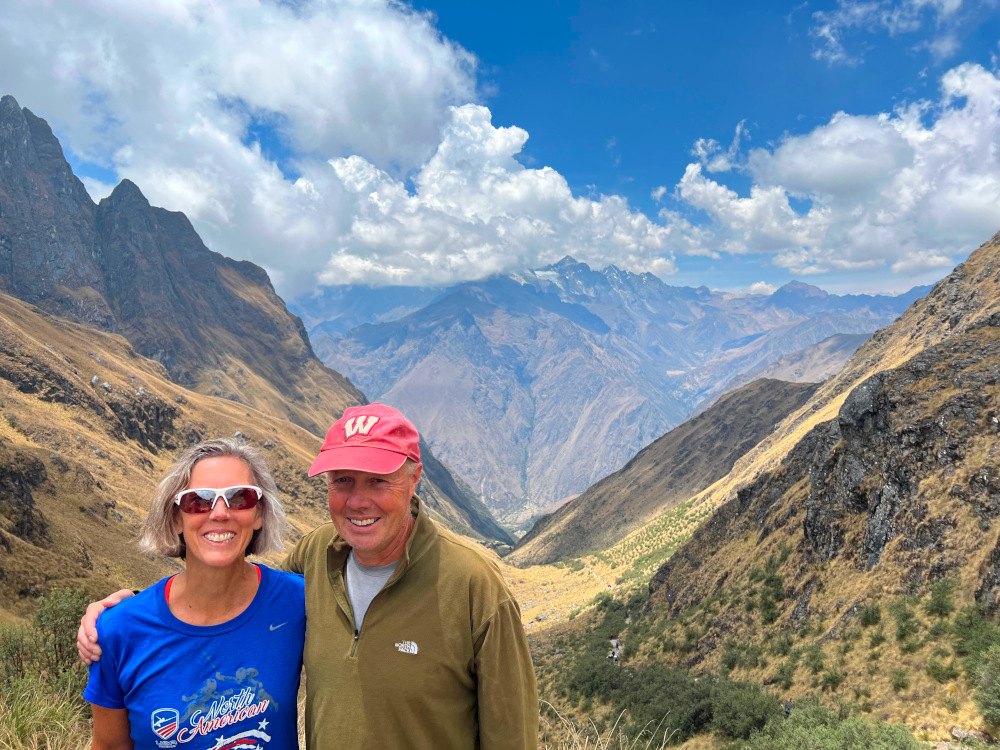
Inca Trail: Dead Woman's Pass

 Temperatures continued to drop as we climbed higher and higher.  It was time to put on the additional layers of clothing from our day packs.


Dead Woman's Pass has that name because the rocks resemble a dead woman in a reclining position.  As we climbed, all of us took turns looking for the dead woman, which also signified the end of the climbing.  So, of course, we saw dead women where there were none--at least not the official dead woman.

Dead woman?  Nope


Stairway to Dead Woman
Keep climbing

Keep climbing


Just a little more

Finally, we made it to the top, where we found the Dead Woman.


There were two guys on the top who had been watching us ascend for the last thirty minutes.  They were waiting for their friend (the guy with the food poisoning) who was behind us and hiking alongside  Freddy, P, and G.  We had been told to expect rain, wind, cold, and maybe snow at the pass, but the views and weather were actually spectacular for about thirty minutes.


Eventually, the rest of our party made it to the top for a group photo.


P told us that he was feeling much better.  Ain't nothing going to stop us now.  


Inca Trail: Ascent to Dead Woman's Pass

I woke the next morning to a flat inflatable sleeping pad, which isn't ideal, but I had a good night's rest. Our alarm clock was one of the pack animals braying just behind our tent.  A few minutes later, a porter came by with a tub of hot water for washing, soap, and cups of steaming coca tea.

We had a quick breakfast and  started hiking just before 7 a.m.  Julia and I were excited for the big day.  Our camp was at 3100 meters (10,170 feet).  Dead Woman's Pass tops out at 4215 meters (13,828 feet).  P still wasn't eating but was determined to power through.  

All smiles on the way up

Within the first hour, we entered high altitude jungle--full of mossy trees and vegetation that you would normally expect at much lower elevation.


Porters

On flat ground or downhill, the porters easily outpaced us.  But this day was all up and steep.  The porters frequently took breaks and we took turns passing each other.


The guy in the above photo was hiking very slowly and deliberately--never taking a break.  We learned from his friends that he was still getting over an extreme case of food poisoning, but there was no "quit" in him.  

Taking a break
Julia re-hydrating

When we stopped at 9:30 a.m. for for the last Gatorade stand on the trail, it was about half-way to the summit.  Temperatures were cooling quickly, and the views were opening up.


Inca Trail: Day One-Huayllabamba

Lunch was excellent, although we noticed that P was still not feeling well and ate little.  After lunch, we headed back up the trail, climbing up switchbacks.  

Most of the other groups that we encountered on the trail were much larger.  In groups larger than eight, one guide was out in front setting the pace, while the second guide was in the rear, making sure that no one was injured or left behind.  During the morning hike, Freddy stayed out in front and kept us close together.  By afternoon, he seemed more confident in our abilities, and he let me lead and set the pace.  For the rest of the week, he hiked from the rear.  Before starting out, Freddy would let me know where to stop ahead at landmarks, where we would take breaks or he would give a short talk about a particular ruin or geographical feature.  

The one rule during hiking was that if porters were coming, you got out of the way so that they could easily pass.  By regulation, the porters' packs were supposed to be limited to 20 kg or 44 lbs, but the reality is that most of them were carrying 50 lbs or more.  What amazed me is that many of them didn't use their hip belts (they were dangling unattached), and many hiked in sandals or cheap tennis shoes.  

There was a small town/gathering of families still higher up the mountain, and the only way to get supplies there was by pack animals--with whom we also shared the trail that day.

Freddy passing on the left


I tried to pass this guy, but he then sped up and walked alongside me for quite awhile.  The pack animals make weekly trips to the market in the valley.  The owner, a young woman, stays at the rear to make sure that no animals stray away.  

I didn't know it at the time, but we were all headed to the same place--Huayllabamba. The first campsite was at the small gathering of families up on the mountain.  


As soon as the young woman unloaded and unpacked the supplies, she set the animals out to graze and then came back with a bucket of cold beer and soda for us.  This was something that I was not expecting and was very grateful.  There was even a flush toilet and a cold shower for anyone willing to brave the water piped directly from the mountain stream  (no one did).

The porters set up our tents and the kitchen.  After the hike and one beer, I was ready for a nap.

Freddy's tent

 
Our tents and view


Dinner included quesadillas, soup, and trout. Everything tasted great, and four of us were famished.  P did not feel well enough to attend dinner. He did not leave his tent after the nap time, except to use the bathroom.   G was starting to get worried and informed Freddy that P was having problems at both ends, digestively-speaking.   

Freddy was also concerned.  Today was a relatively easy hike. Tomorrow would be the hardest day with the very steep climb to Dead Woman's Pass and the highest elevation at almost 14,000 feet. Once we were on the other side of the pass, evacuation would be difficult if P's situation got any worse.   P had experienced altitude sickness during a successful summit at Mount Kilimanjaro during a pre-pandemic hike, but expected to battle through the Inca Trail because Kilimanjaro is significantly higher in elevation.

We didn't stay up long after dinner.  Sunset was at 6 p.m.  Sunrise was also at 6 a.m.  Every day of the year at the equator.  Tomorrow would be a big day.  I was proud of Julia; she had hiked just as well as the guys more than twenty years younger. 

Sunset


Inca Trail: Day One-Morning

Neither of us slept much on the night before the hike started.  We were  laying awake when the alarm went off at 4 a.m.  After a quick shower, knowing that there wouldn't be another one for awhile, we headed out to the lobby for the 4:30 a.m. van pickup.  

Freddy (our guide) and P&G, our companions, were waiting out front.  It was about a three hour drive before we stopped in a small town to meet up with our porters, who all live in the town near the trailhead.  Freddy gave us 30 minutes to have breakfast and coffee. During that break, "P" confided to us that he hadn't been feeling well since arriving in Cusco.  He was already taking prescribed Diamox as a preventative for altitude sickness.

About thirty minutes later, we arrived at the trailhead.  Before each day, Freddy gave us an idea about what to expect from the trail.  This day would be the flattest and shortest day with a gradual incline in the morning and steeper "ramps" later in the day.  

We took pictures at the beginning of the trail and then crossed the footbridge at about 8:30 a.m.

P,G,J&J

Freddy's trail descriptions were always accurate, which is a good thing in terms of setting expectations.  Things were easy in the beginning, and there were some small luxuries that we enjoyed.  Due to being close to the trailhead town, small entrepreneurs set up small snack stores along the first part of the trail.  Here, Julia and I stopped for fresh squeezed orange juice.  Freddy and G had smoothies. 


The trail continued along on flat or gradual terrain.

Then Freddy turned to us and said, "Here, things will change."  That was pretty much the last we saw of flat trail during the week.

Heading Up


Looking back down

On the other side of the knob, we looked down on Inca ruins and terraced agricultural fields.


Continuing higher up, we came across ruins that we could explore on our own without other tourists.


We continued to climb until about 11:30 a.m. when we met up with our porters and cook, who were preparing lunch.  This is where my hiking experience diverged from any other hikes that I've ever done.  The porters laid out tarps for our backpacks.  A cooking/dining tent was set up.  On one side of the partitioned tent, our cook and his helpers prepared a three course meal for lunch.  On the other side, there was a small table and chairs set up for Freddy and the four "guests."  We often had popcorn as an appetizer and then some kind of soup.  That was followed by the main course, which varied.  Water was taken from whatever source was available, boiled, and then cooled to be available to refill our water bottles.  Coca tea was also available. 

Waiting for lunch to be served


Sacred Valley

 The Sacred Valley, a/k/a Urubamba Valley, lies north of Cusco along the Urubamba River between Pisac and Machu Picchu.  Here is where the Inca focused upon agriculture, due to a lower elevation compared to Cusco.  

We were up before the chilly dawn for our tour, eating breakfast next to the fire in the hotel dining room.


This tour was not private and was combined with people from other tour companies.  We climbed into a packed van with about a dozen other people from all over the world.  Interesting to us, there were more non-English speakers than English speakers, representing Brazil, Spain, and El Salvador.

 The guy sitting next to us was an Asian guy about our age from Florida.  He would be hiking the Inca Trail a few days after us, so we shared notes about preparation as older hikers. 

Unfortunately, one of the Spaniards was ill and hacking up a lung.  Later, the other two began coughing frequently.   Before the end of the day, the sickest one, an older woman, was laying down across two seats in obvious distress.  Her husband gave the opinion that it was altitude sickness.  Now, difficulty breathing is a sign of altitude sickness, but I've never heard of constant coughing as a legit symptom.  Let's just say that I had Covid concerns.

Because it was a private van and tour, there was no masking requirement.  Julia and I started off as the only ones masked, but others eventually joined. The tour van made frequent stops for photo opportunities, and I practically leaped out of the van, scrambling for fresh air. 

Sacred Valley--first photo opp

 Our first longer stop was at the Pisac ruins.

Crops were terraced to avoid erosion.  Potatoes were grown at one elevation and corn at another.  Waterways provided irrigation.  Six hundred years ago, the Incas had a pretty good grasp for agriculture.


After the ruins, we stopped at a small town known for making silver jewelry.  Naturally, Julia found something that she needed. Upon leaving the store, she encountered a young woman who makes a living posing for cute pictures with tourists holding  baby alpaca.  There is no set donation; you pay what you think is fair.  Tourism suffered greatly during the height of the pandemic, so people were being generous.

We then headed to a buffet lunch with a wide array of Peruvian dishes to choose from.  This was an opportunity to try Peru's national dish, cuy, better known as guinea pig.  They are sold whole in the markets but there was a stir fry dish at the buffet.  I've tried it and do not need to try it ever again.  Tastes a little bit like chicken but with lots of tiny sharp bones.

Then there were more ruins at the town of Ollantaytambo. 


I walked more steps this day than on the first day of the Inca Trail.


natural waterway

We had one last stop to make--one that Julia had been waiting for all day.  In Chinchero, our tour company stops at a different weaver's home every day.  This family hosted us for tea, demonstrated natural dyes, and offered assorted woven pieces for sale.  


the weavers bonding

We then wandered about the town, where we found other weavers working and selling.

Back strap loom


Supper

After a long day and van ride back home, we were ready for supper but opted for something more familiar:  pizza and a jug of house wine.  The small Italian restaurant in Cusco looked like something from an Italian mountain village with an old guy pulling pizzas from an ancient oven.  We must have been famished because we didn't leave a pizza crumb or drop  of wine behind.  Then it was off to bed at 9 p.m.  The alarm would ring for the Inca Trail at 4 a.m. on the next morning.

Camping with Elon?

 This interesting rig was in our campground last night. The trailer appears to be a prototype from a California start-up company.