After a short stop at the Grant River Recreation Area, I continued meandering north on the Great River Road,
mostly on Hwy 133, until I reached Governor Nelson Dewey State Park. I
could find only a few short trails on top of the bluffs here, which I
hiked quickly. Then I found a picnic table and made breakfast,
consisting of French press coffee, fried eggs and toast, all prepared on
my little Coleman backpack stove.
I brewed the coffee with home roasted Brazilian from Thursday
morning. I was lazy and ground for french press before I left.
Coarsely ground coffee stales more slowly than finely ground coffee, due
to differing amounts of oxidation (less surface area exposed for
coarse). This cup tasted particularly good in the crisp morning air and
brisk wind on top of the bluff.
My intended destination was Perot State Park north of La Crosse, but I
never got there. Continuing on the Great River Road, I found myself at
the entrance of Wyalusing State Park, just south of Prairie du Chien,
WI. I’m not sure if I ever visited this park before, but I immediately
fell in love with an available campsite on top of the bluff. When I
found out that there were more than ten miles in hiking trails also, I
booked the campsite for two nights.
Wyalusing is a historically important park Below these bluffs, you
can see where the Wisconsin River meets the Mississippi River. On May
17, 1673, Father Jacques Marquette’s expedition left St. Ignace,
Michigan at the northeast tip of the Upper Peninsula of Michigan. The
men followed close to Lake Michigan’s shoreline into Green Bay and then
entered the Fox river, which empties into the Wisconsin River near
Portage, Wisconsin.
They continued to canoe to the place below, where
the train now crosses. On June 17, 1673, Father Marquette wrote:
“After 40 leagues…we happily paddled into the Mississippi with a joy I am unable to make known.”
Today,
these trains run frequently, all day and all night. On of the
advantages that my Ford Escape has over a tent is soundproofing. I
slept without any interruption both nights of my stay. I like the sound
of trains, just not when I’m trying to sleep.
These bluffs also mark the Passenger Pigeon Memorial. A memorial plaque states:
“Dedicated to the last passenger pigeon shot at Babcock,
September 1899. This species became extinct through the avarice and
thoughtlessness of man.”
That
afternoon and evening, I read the latest C.J. Box novel from my chair
at the top of the bluff. I dined on ravioli with butternut squash, and
French bread with goat cheese, washed down with a tin cup or two of
Rodney Strong’s Cabernet Sauvignon. The sunset was amazing.
Reading blog posts and watching Youtube videos about rv and van
life, one of the things that gently shocked me is that people sleep
overnight in Walmart parking lots. For years, many (but not all)
Walmarts have made their parking lots open to motor homes and travel
trailers for overnight stays and sometimes longer. For people who like
Walmarts, I suppose it has some advantages. A parking lot stay is
cheaper than a campground. Security keeps an eye on the parking lot.And if you need something, it’s just a short walk across the parking lot
to a Walmart.
But it’s not just motor homes and travel trailers. Some people stay
overnight in converted vans, mini-vans, or (gasp) cars. Online, I’ve
seen some fascinating conversions of cars as small as a Prius that have
been converted into tiny camping vehicles with beds. That made me
wonder if my Ford Escape could be set up for camping. Thanks to the
Internet, I found that it’s been done before. The back seat of a Ford
escape partially folds down. But if you remove the seat part of the
back seat, it folds down all the way flat. By sliding the front
passenger seat all the way forward, I actually have room to stretch out
my 5’11” frame comfortably on top of a thick foam sleeping pad.
Now you might think I’m going to tie the above two paragraphs
together and admit to sleeping in my car at the local Walmart parking
lot, but you would be wrong. Though I’m not overly fond of Walmarts, my
wife has an intense dislike of Walmarts, and she would literally hold
it against me if I ever overnighted there. In fact, when I first
mentioned that some people camp in Walmart parking lots, she almost lost
it and said:
“We…will…never…camp…in…a…Walmart…parking lot.”
So, anyway, back to the story. I planned a weekend of camping and
hiking along the Mississippi River in western Wisconsin, but I couldn’t
leave until after supper on Thursday night so that Julia could take over
care for Justin, our son in a power wheelchair. I didn’t really see
the point in paying for camping on Thursday night. I would be setting
up in the dark and not able to enjoy the park at all on Thursday, except
for sleeping. It seemed like a good time to try stealth sleeping in
the Ford Escape, especially because predicted temperatures were in the
high 20’s.
Because I wasn’t going to sleep in a Walmart, I got online to do some
research. Surfing over to freecampsites.net, I learned that the Mystique Casino
in Dubuque, Iowa has allowed RV campers to overnight in the past.
Unfortunately, the Mystique changed its name to the Q Casino, and I
couldn’t find any recent reports that camping was allowed after the name
change. The last report was four years ago. I decided to take my
chances.
After arriving at the casino parking lot around 8 p.m. I circled
around a bit to see where the other “Rv’s” were parked. Unfortunately, I
didn’t see any. There was an area of the parking lot in the back
(towards the river) where several semi-trucks parked. I moved far
enough away from the trucks so that I couldn’t hear or smell the diesel
engines, and backed in close to the dog kennel fence (there’s a dog
racing track here too), so that people couldn’t walk behind my Escape.
Then I walked into the casino and enjoyed myself for a couple of
hours. I had a pretty good steak sandwich with fries, accompanied by two
Saga IPA’s, brewed by the Summit Brewing Company in St. Paul,
Minnesota. I walked around, watched people play roulette, poker, and
slots. After a stop in the nice indoor bathrooms, I quietly slipped into
the back of my SUV.
It was 29 degrees when I woke up at 6:30 a.m. No wake-ups by
security. I parked far enough away from the crowd that I didn’t hear
another person all night. In the morning, my front window frosted up
(on the inside). After a couple of minutes of scraping, I headed back
across the bridge to Wisconsin.
A few miles up the road, I found the Grant River Recreational Area,
which includes an Army Corps of Engineers’ campground along the
Mississippi River. It was so peaceful and quiet. My mind felt at ease,
as I continued my weekend on the Mississippi River.
Last week, I traveled with my son to New Orleans for the high
school’s band and chorus trip which takes place every two years. While
the rest of the students traveled in coach tour buses, we made the trip
in the wheelchair van. A bus with a
wheelchair lift was a possible option, but taking one of those buses
would have increased the trip’s cost for each student (fewer seats due
to the lift). In the end, I’m not sure that it ended up any less
expensive for the school district, given that our mileage expenses are
to be reimbursed, but perhaps it was a way to shift costs from the
students to the district. I actually didn’t mind that much. I like to
drive, and I prefer the van to a large noisy bus.
Day 1:
We got up early on Monday morning and drove
to St Louis, where we toured the City Museum during the early
afternoon. Unfortunately, while the museum was accessible, many of the
activities were not. The primary city architect exhibit was closed, so
the main attraction were different slides and tunnels that are not meant
for power wheelchair users. The next scheduled stop was a shopping
mall with a huge food court. Justin and I elected to skip that stop and
get a head start towards New Orleans.
We made it past Jackson, Mississippi to a rest area around midnight.
While I’ve camped in many different places around our country, this was
my first “overnight” at a rest area. It’s not something that I would
probably repeat in a car, unless necessary.
Day 2
At 4:30 a.m., Justin woke me up, saying it
was time to get back on the road. Within five minutes after I started
driving, Justin fell back to sleep again. We drove until about 6 a.m.
and then stopped at a Waffle House for eggs,bacon, potatoes, and grits.
After filling up with food, we felt much better and made it to New
Orleans by 9 a,m. We joined up with the students on the buses at around
9:30 a.m.
The first stop was St. Louis Cemetery No. 1 and was actually one of
the highlights of the trip for Justin. Our tour guide was an older
African-American woman who took a quick liking to Justin and tucked him
under her wing for the entire tour. The most interesting thing I
learned on the tour related to the year and a day rule for New Orleans
cemeteries.
Bodies are buried above ground in New Orleans due to the high water
table. For the first year and a day, bodies are placed in wooden
coffins and then are stored in drawers intended for that purpose. This
is essentially a composting system. Exposed to high temperatures and
humidity, the bodies break down over that period and become much
smaller. After the year and a day, the remains are removed from the
coffins and placed in the final resting place. In this way, many bodies
can be placed in a tomb. The coffin drawers are then reused. Very
green, and they’ve been doing it this way for many years.
The
tour concluded with Justin (now nicknamed “Speedy”) giving the tour
guide a big hug. Justin might protest a bit, but he is a kid that likes
being in the limelight.
We then walked down to the French Quarter, passing Bourbon Street and
ending up at Jackson Square. The Fried Oyster Po’ Boy sandwich at
Stanley’s was terrific.
By 3 p.m., we were finally able to check into the hotel in nearby
Metairie, LA. It was a good thing. Justin’s wheelchair did not receive
its normal overnight charge, so he was literally running on electric
fumes. We rested up for a few hours, recharged, and then enjoyed a
nondescript meal at Hard Rock Cafe with the rest of the group before
going back to the hotel for much needed sleep.
Day 3:
On Wednesday, Justin sang with his choir at a residential facility for assisted living and memory care.
During the afternoon, the choir sang at a local episcopal church and school.
For dinner, we enjoyed more fried seafood at Mulate’s Original Cajun
Restaurant. A Cajun band entertained afterwards, and many of the kids
danced in front of the stage. Accessibility here required some
ingenuity. Justin was able to access the bathroom by rolling through
the restaurant’s kitchen as workers pressed up against the wall to let
him through.
Day 4:
The high school band was supposed to perform
on Thursday morning near Jackson Square, but we were rained out about
the time the buses arrived. Then it was back to the hotel for awhile
until it was time for the swamp tour given by Cajun Pride Swamp Tours in
Laplace, LA. Because it was still raining, we swapped the electric
wheelchair for a folding manual chair bungee corded to the inside wall
of the van. Fortunately, one of the boats was accessible via ramp. It
was tight, but we rolled to a spot right next to the captain.
On the tour we saw several large alligators that the captain drew
right up next to the boat by generous baiting with marshmallows. He
basically fed them right out of his hand when they got close enough.
The captain showed us the nicks on his hand, which occurred when he
wasn’t quite quick enough. It was very entertaining. Justin was able to
hold a baby alligator that was passed around inside the boat.
Unfortunately, I don’t have any photos, leaving my camera behind in the
car due to the heavy rain.
In the afternoon, the rain stopped in time for us to tour the Oak
Alley Plantation. Only the first floor was accessible. Justin and I
were able to cruise around the grounds and view the slave quarters.
That night, we enjoyed dinner at the Bubba Gump Shrimp Company
restaurant back in New Orleans. My food wasn’t that great, but the kids
had a good time.
Day 5:
This was our last day, so we checked out of the hotel in the morning. We then toured the New Orleans Museum of Art (NOMA).
There were some interesting pieces, but Justin and I were done with
it after 45 minutes. We then spent a couple of hours enjoying the sunny
weather at the adjacent Sydney and Walda Bestoff Sculpture Garden.
After eating lunch at the nearby Courtyard Cafe (Justin had alligator
sausage, and I had crawfish etoufee), we toured Mardis Gras World where
artists design and build floats for the next Mardi Gras. We were asked
not to put photos online so as not to spoil next year’s parade.
The trip wrapped up with the Nachez Steamboat Dinner Jazz Cruise. We
weren’t sure if the boat was going to leave without us due to a freight
train stopping on the tracks, blocking access to the boat. After a 45
minute wait, the train finally started up again, allowing us to board.
The food was good, and the views were fantastic. It was a great way to
end the trip.
While the calendar indicates that spring started a few days ago,
temps struggled to get out of the 30’s today. The southwest wind was
brisk. Fortunately, the Merrimac Ferry was open, saving me from driving
around Lake Wisconsin on the way to Devil’s Lake State Park near
Baraboo. When the Wisconsin River is iced over, the Ferry does not run.
It opened early this year, closed due to ice conditions, and then
reopened recently.
Winter
is still hanging on tight by its fingernails. The leaves are brown.
There are snow remnants scattered in the corners of the park, and some
ice remains on the south shore of the lake.
I hiked my usual route around the lake, starting with the east bluff
trails. This route starts with the Balanced Rock Trail. This is
basically a climb straight up the rocks to the top of the bluff–short
and steep.
It’s actually not that bad. There is a trail. See if you can find it in the photo below.
About half-way up to the top, there are a couple of small signs alerting you to look off to the right for the “Balanced Rock.”
The Balanced Rock is quite impressive. I may have ventured off the trail a
bit for the close-up. Watch your footing. It’s a long ways down.
After reaching the top of the East Bluff, I followed the trail along
the top and then down to the north side of the lake. Heading towards
the beach, the trail passes along several Indian burial mounds. On the
other side of the beach, there is a steep ascent up stairs to the top of
the West Buff Trail. I followed that trail back to the south side of
Devil’s Lake. After coming down from the bluffs, the trail follows the
edge of the lake, passing by fishing areas, the dog beach, and the no
dog beach. The circle route took about two hours. I didn’t have time
for another long hike, but there was just enough time to visit a nearby
favorite spot.
Pewits Nest:
This Wisconsin State Natural Area is a hidden gem that not many
people know about. Just a few miles west of the Walmart in Baraboo, the
Pewits Nest parking lot is on County Highway W.
During
the summer, this is a terrific place to wade upstream and cool off.
Some foolish people (I won’t mention any names) climb down a bit from
the bluffs and jump into that pool after the small waterfall. I like to
cool off, and I like to jump. But I don’t jump into pools of water of
varied and unknown depth.
I’m glad I took the opportunity to hit the trail today. Tonight, the
thunderstorms have started, and I’m tucked in near the wood stove.
The Alchemist by Paulo Coelhois was recommended by a couple of vagabond travelers that I follow on YouTube (Finding Simon and Chris from Chris and G Travels).
They both liked it; Chris described the book as life-changing. When I
checked for copies at the local library, I discovered an audio version
that my son and I could listen to together. We finished it today.
While I wouldn’t say that the book changed my life, we both enjoyed
it. For me, the book makes a strong argument that the most important
part of daily living is to follow your dreams, and that everyone has a
different dream. Importantly, failing is sometimes part of following
one’s dream. Until we have failed and grow/learn from failing, we can’t
take the next step.
Today,
I rose early and took a few moments to admire the sunrise from my front
yard. After getting Justin ready for school, taking him swimming, and
sending him off to class, I headed down to Madison for my haircut. I’ve
had a lot of barbers over the years, but my current one is my favorite.
There isn’t a lot of hair left for him to cut, but he does a good job
with what there is to work with. I enjoy hearing his stories; and he
seems to enjoy hearing mine.
Because I arrived early, there was an opportunity to take a short
hike. I sprinted across four lanes of morning traffic, as only a man in
his 50’s can do, and then sauntered over to a park along Lake Mendota.
Mid-March, yet no ice is on the lake. On the other hand, no one was hanging out on the beach yet with temps in the 40’s.
Later,
I went to my son’s spring music concert. Justin is no longer able to
walk or stand due to advancing muscular dystrophy. His “normal” is very
different from the “normal” for most people. Having said that, he does a
lot with what he has.
This morning, he swam. Tonight, he sang.
We all have dreams to follow. We may not all realize our dreams, but there is no hope unless we try.
My first view of a molded fiberglass trailer was a Burro owned by
my wife’s Grandpa Aubrey back in the 1980’s. Burros were manufactured
in Iowa from 1978 to 1986. This isn’t Aubrey’s trailer but it looks a
lot like that one.
Sometimes,molded fiberglass trailers are called eggs, due to their
curved shape and white appearance. Over 50 different manufacturers have
made molded fiberglass trailers over the years.
What do I like about fiberglass trailers? The material is light and
strong. Fiberglass trailers are made in molds with the two halves fitted
together along the midsection or belly of the trailer. Are fiberglass
trailers leakproof? No, because anywhere there’s an opening, such as an
air conditioner, window, or vent, there’s the potential for a leak.
But that’s true for stick built trailers also.
What you don’t have are
seams in the roof. Now that I look at the photo though, it looks like
Burros were made with the seam running right down the middle of the
roof. All of the ones that I’m considering are made with the belly
seam.
One thing different about buying fiberglass trailers is that you are
buying directly from the manufacturer. Most of the companies are small
family businesses that do not have a dealer network. Advertising
budgets are small. It’s not uncommon for customers to meet the
president of the company when picking up the trailer.
It’s time for the top three contenders. I would be happy to own any of these three trailers,
The second runner-up is the Scamp, manufactured in Minnesota.
This
is an older Scamp 16 that was posted for sale. You can see the seam on
the midsection that fits the two halves together. Scamp has different
sizes in fiberglass trailers: 13′, 16′, and 19′. The largest is a fifth
wheel trailer. We like the 16′ size because you can get a dedicated
bed and a dedicated table. The deluxe model of the 16′ trailer starts at
$20,000 and includes a great list of standard features, including all
wood cabinets, shower/toilet, configuration for separate bed and table,
and interior height of 6′ 3″.
Scamps have great resale value. If we had a problem, the Scamp
factory is a long day’s drive from our home. Scamps are well
insulated. I’ve even seen them used for ice fishing houses. Scamps are
so popular that if you order one now, delivery won’t be made for about a
year, given the high demand and back orders.
Why did the Scamp come in third? The design for Scamp is time
tested, but the features are dated compared to the two trailers coming
in first and second. Additionally, Scamp allows very little
customization. There is no solar power option at this date. Reports of
quality control are mixed, although most people love their Scamps.
Finally, rivets are used extensively in the Scamps. I’m not fond of
rivets. Having said all that, if a good deal locally came up on a used
Scamp, I just might pull the trigger.
The first runner-up is the Little Snoozy,manufactured in South Carolina.
Again, the fiberglass seam runs along the midsection. The Little
Snoozy has the most modern design of the fiberglass trailers that we
considered. The rear entry door is a very nice feature, which allows
long items to go inside without having to make it around a tight corner
(compared to the side door of the Scamp). The air conditioner is on the
back, rather than the roof. That make the height of the trailer more
manageable to fit into garages.
The interior is amazing.
The bed is large. The jackknife sofa in the living room is a nice
alternative to the standard dinette table. The windows and wood
cabinetry are very attractive and functional. I like this trailer a
lot. But there are a couple of “features” that are holding me back from
pulling the trigger on ordering a new one.
First, the Little Snoozy does not have a black tank. You can either
get a portapotty or cassette toilet. In either case, you are hauling
the waste to a toilet rather than dumping the black tank at a dumping
station. This is personal preference, but I prefer the black tank.
Second the Little Snoozy is not designed to take advantage of
propane. The refrigerator is electric. The stove is electric. For
camping off the grid, this is a huge disadvantage. Little Snoozy does
not offer installation of solar as an option although some customers
have added it themselves. Some customers have even added propane later.
If I was only going to camp at campgrounds with electric hookups, this
would be my first choice. If I bought this trailer, I would add solar
and maybe change out the refrigerator for one that was more efficient. I
would pack a propane stove. It’s too bad. I really like this trailer.
Little Snoozy trailers start at $21,500. (Author's Note: Little Snoozy went out of business after this post came out).
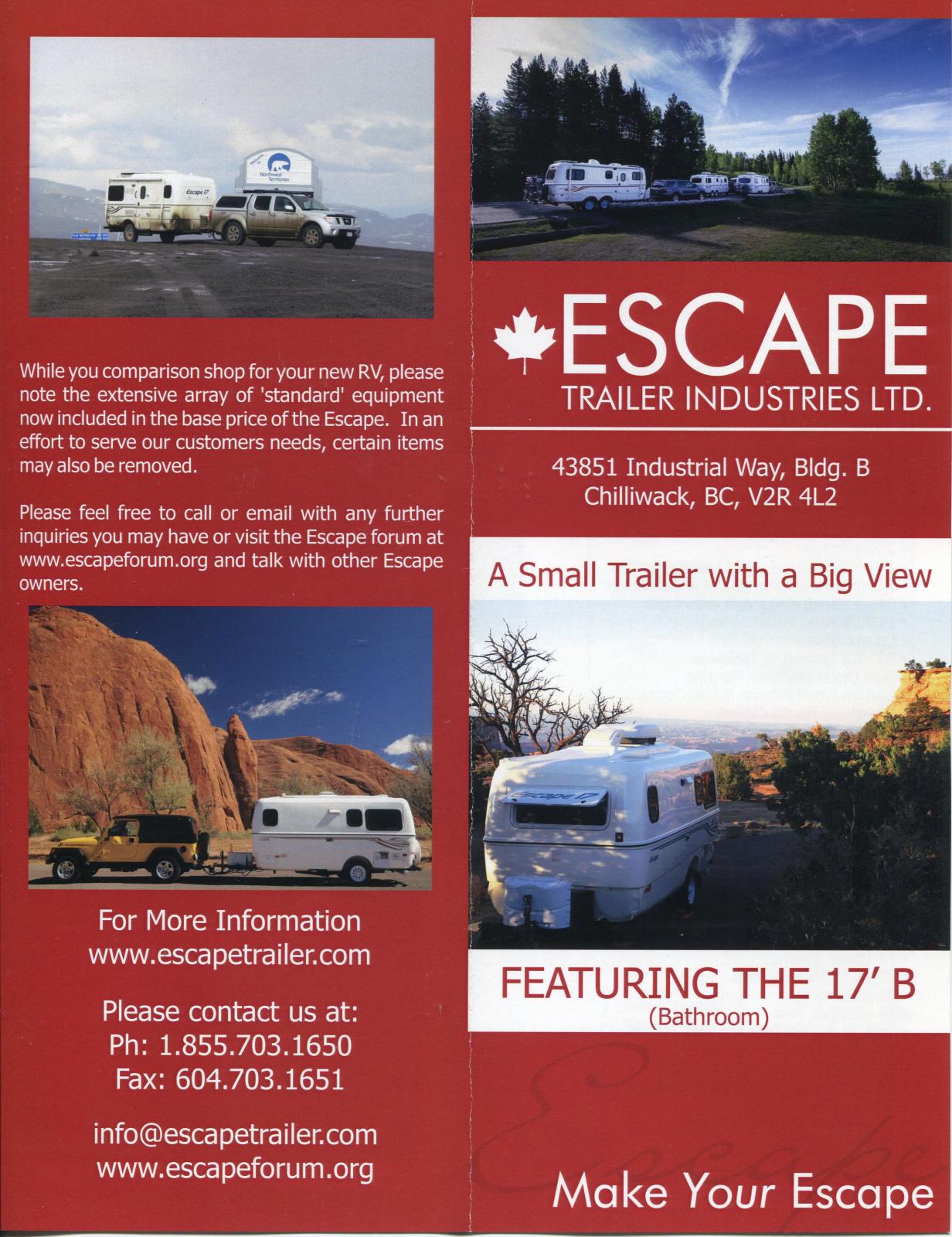
And the winner is….the Escape 17B from British Columbia, Canada.
There
are so many things I love about this trailer that’s it’s hard to know
where to start. I know. Let’s start with the negatives.. It’s made in
western Canada–about a three-hour drive north of Seattle, Washington.
That’s a long ways to go to pick up the trailer. It’s also a long ways
to go if I need the manufacturer to do any work on the trailer.
Finally, I have no idea what’s going to happen to the cost of importing a
trailer under the current Trump administration. I also have no idea
what’s going to happen to the value of the American dollar vs the value
of the Canadian dollar. The price of the Escape is in Canadian dollars.
Now that all of the bad stuff has been disclosed, let’s move on to
what I like about the Escape 17b. I’ve been following fiberglass
trailer user forums for about six months. Escape owners stand out
because really love their trailers. They love the quality. They believe
in the owners of the company. They get excited about Escape quality
control. Escape owners get really excited about the customization and
options available during the manufacturing process.
In my opinion, Escape has more options and amenities available than
any other fiberglass trailer maker. Installation of solar panel with
charge controller. Check. A no rivet system. Check. Stainless steel
sink and faucet. Check. Will install two 6 volt batteries. Check.
Added wall insulation and window installation. Check. Power awning.
Check. Furnace, refrigerator, stovetop, all capable of running on
propane.. Check.
These three photos are from the ad for a rare used escape for sale.
These trailers are seldom found on the used market. About the only time
an Escape owner sells a 17B is to move up to an Escape 19 or 21.
What about cost? That’s a tricky question, and it’s hard to compare
apples with apples. The Escape 17B starts at $27, 900 Canadian, which
currently converts to under $21,000. However, we all know that
currencies fluctuate. It wasn’t that long ago that the U.S. and
Canadian currency had equivalent value. Add the Trump wild card to
import taxes/tariffs, and I’m not sure where this will all end up for
the summer of 2018, which is when I want to have my fiberglass trailer.