Inca Trail: Day One-Morning

Neither of us slept much on the night before the hike started.  We were  laying awake when the alarm went off at 4 a.m.  After a quick shower, knowing that there wouldn't be another one for awhile, we headed out to the lobby for the 4:30 a.m. van pickup.  

Freddy (our guide) and P&G, our companions, were waiting out front.  It was about a three hour drive before we stopped in a small town to meet up with our porters, who all live in the town near the trailhead.  Freddy gave us 30 minutes to have breakfast and coffee. During that break, "P" confided to us that he hadn't been feeling well since arriving in Cusco.  He was already taking prescribed Diamox as a preventative for altitude sickness.

About thirty minutes later, we arrived at the trailhead.  Before each day, Freddy gave us an idea about what to expect from the trail.  This day would be the flattest and shortest day with a gradual incline in the morning and steeper "ramps" later in the day.  

We took pictures at the beginning of the trail and then crossed the footbridge at about 8:30 a.m.

P,G,J&J

Freddy's trail descriptions were always accurate, which is a good thing in terms of setting expectations.  Things were easy in the beginning, and there were some small luxuries that we enjoyed.  Due to being close to the trailhead town, small entrepreneurs set up small snack stores along the first part of the trail.  Here, Julia and I stopped for fresh squeezed orange juice.  Freddy and G had smoothies. 


The trail continued along on flat or gradual terrain.

Then Freddy turned to us and said, "Here, things will change."  That was pretty much the last we saw of flat trail during the week.

Heading Up


Looking back down

On the other side of the knob, we looked down on Inca ruins and terraced agricultural fields.


Continuing higher up, we came across ruins that we could explore on our own without other tourists.


We continued to climb until about 11:30 a.m. when we met up with our porters and cook, who were preparing lunch.  This is where my hiking experience diverged from any other hikes that I've ever done.  The porters laid out tarps for our backpacks.  A cooking/dining tent was set up.  On one side of the partitioned tent, our cook and his helpers prepared a three course meal for lunch.  On the other side, there was a small table and chairs set up for Freddy and the four "guests."  We often had popcorn as an appetizer and then some kind of soup.  That was followed by the main course, which varied.  Water was taken from whatever source was available, boiled, and then cooled to be available to refill our water bottles.  Coca tea was also available. 

Waiting for lunch to be served


Sacred Valley

 The Sacred Valley, a/k/a Urubamba Valley, lies north of Cusco along the Urubamba River between Pisac and Machu Picchu.  Here is where the Inca focused upon agriculture, due to a lower elevation compared to Cusco.  

We were up before the chilly dawn for our tour, eating breakfast next to the fire in the hotel dining room.


This tour was not private and was combined with people from other tour companies.  We climbed into a packed van with about a dozen other people from all over the world.  Interesting to us, there were more non-English speakers than English speakers, representing Brazil, Spain, and El Salvador.

 The guy sitting next to us was an Asian guy about our age from Florida.  He would be hiking the Inca Trail a few days after us, so we shared notes about preparation as older hikers. 

Unfortunately, one of the Spaniards was ill and hacking up a lung.  Later, the other two began coughing frequently.   Before the end of the day, the sickest one, an older woman, was laying down across two seats in obvious distress.  Her husband gave the opinion that it was altitude sickness.  Now, difficulty breathing is a sign of altitude sickness, but I've never heard of constant coughing as a legit symptom.  Let's just say that I had Covid concerns.

Because it was a private van and tour, there was no masking requirement.  Julia and I started off as the only ones masked, but others eventually joined. The tour van made frequent stops for photo opportunities, and I practically leaped out of the van, scrambling for fresh air. 

Sacred Valley--first photo opp

 Our first longer stop was at the Pisac ruins.

Crops were terraced to avoid erosion.  Potatoes were grown at one elevation and corn at another.  Waterways provided irrigation.  Six hundred years ago, the Incas had a pretty good grasp for agriculture.


After the ruins, we stopped at a small town known for making silver jewelry.  Naturally, Julia found something that she needed. Upon leaving the store, she encountered a young woman who makes a living posing for cute pictures with tourists holding  baby alpaca.  There is no set donation; you pay what you think is fair.  Tourism suffered greatly during the height of the pandemic, so people were being generous.

We then headed to a buffet lunch with a wide array of Peruvian dishes to choose from.  This was an opportunity to try Peru's national dish, cuy, better known as guinea pig.  They are sold whole in the markets but there was a stir fry dish at the buffet.  I've tried it and do not need to try it ever again.  Tastes a little bit like chicken but with lots of tiny sharp bones.

Then there were more ruins at the town of Ollantaytambo. 


I walked more steps this day than on the first day of the Inca Trail.


natural waterway

We had one last stop to make--one that Julia had been waiting for all day.  In Chinchero, our tour company stops at a different weaver's home every day.  This family hosted us for tea, demonstrated natural dyes, and offered assorted woven pieces for sale.  


the weavers bonding

We then wandered about the town, where we found other weavers working and selling.

Back strap loom


Supper

After a long day and van ride back home, we were ready for supper but opted for something more familiar:  pizza and a jug of house wine.  The small Italian restaurant in Cusco looked like something from an Italian mountain village with an old guy pulling pizzas from an ancient oven.  We must have been famished because we didn't leave a pizza crumb or drop  of wine behind.  Then it was off to bed at 9 p.m.  The alarm would ring for the Inca Trail at 4 a.m. on the next morning.

Texile Collective and Trekking Orientation

One of the reasons for the Peru trip is that Julia has become very interested in the weaving hobby.  She is on the programming committee  for the Madison Weavers' Guild.  After our Cusco guided tour, we walked over to the Textile Collective.  In truth, I stayed outside on the sidewalk and people-watched on the busy downtown street, which is more interesting to me.  But I took no photos, and Julia did, so here we go:


 Here is the website link, if you want to read and see more.

That night, we met with Freddy, our Inca Trail Guide, and met our companions for the Inca Trail hike, which was to begin two days later.

P&G are a male couple from Scotland who had been enduring travel hell for the last few days.  Their suitcases, and all of their gear, were still lost somewhere in Europe.  Two different airlines were blaming the other.  

What made things interesting was that P's bag had an Apple AirTag in it, so they knew that at least one of the bags was somewhere at the Madrid airport.  The end result was that they had spent the last few days in Lima, buying all new trekking gear at the North Face store at very high prices. 

During the orientation, Freddy explained that the porters would be carrying our tent, sleeping bag, sleeping pad, and 7.5 lbs of our personal gear. We would be carrying day packs only.  The hotel desk had a scale, and I was well under the limit; Julia was exactly at the limit.  The van would pick us up at 4:30 a.m. for the two hour drive to the trailhead.  

Freddy then turned very serious and said, "I have to talk about something that nobody wants to talk about.  I have a first aid kit and an oxygen bottle for emergencies, but sometimes it is necessary for people to stop hiking and be evacuated for any number of medical reasons.  This will be very expensive, especially if it's a helicopter evacuation.  You will be transported to the nearest town and then it will be up to you to pay for any medical care and to get back to Cusco.  Again, this will be very expensive.  Carry extra cash and credit cards for this purpose."

We kind of all looked at each other,  hoping that this would never come to fruition. During the actual hike, events ensued that reminded us of this part of the part of the orientation.

Justin's Shower and the Zoo

 Now that Julia is back home, we have been working to get Justin's apartment shower to be accessible.  There is a lip of four inches outside of the shower and a drop of about three inches into the shower.  The space in front of the shower is tight and faces his laundry closet.  

We bought a curb ramp to address the outside lip. It's a short and steep up for a shower chair moving sideways.  For the inside, we are trying out a perforated rubber mat on the bottom, paving stones on top of the rubber mat, and then another rubber mat on top.  This still leaves a way for the water to drain.  

His staff has been doing sponge baths for over a month, but the house manager isn't happy about that as a long term plan.  Justin is fine with the sponge baths and isn't thrilled about the potential bumpy ride in and out of the shower.  Even when he had a walk-in shower in the dorms, he was only showering once per week to supplement sponge baths.

Sunday morning, we will try it out and see if the plan (and Justin) works. We will go slow.  We practiced with the empty shower chair, but adding 180 lbs to the shower chair will be a significant change. 

We dragged Justin out of his apartment yesterday and walked over to the nearby Madison zoo with one of his caregivers.  Justin never wants to leave but is usually happy when he finally gets outside.  Yesterday was a nice sunny day in the 60's, and he didn't get too cold (Justin never wears long pants or shoes--even in the middle of winter).

We then ordered a Wisconsin fish fry for carry-out, and then watched some of the Milwaukee Bucks' basketball game at Justin's apartment.  Watching tv sports and playing video games is how Justin currently spends most of his time.  

I have to say that he has been doing a better job of managing his personal finances.  He successfully negotiated  receiving both energy and internet subsidies for low income folks.  Justin also has an appointment next week with Wisconsin Department of Vocational Rehabilitation to see about part time job options.  And he figured out a way to get an absentee ballot for his new address and voted!


Cusco Tour

 Julia and I generally do not sign up for tours, preferring to look things over on our own.  In fact, on the day before our guided tour, we went to the market on our own and and enjoyed that experience.  


But when you are in a foreign land, there are some questions that you just can't answer without the help of a local.  Like what the heck is that?

As I mentioned before, one doesn't hike the Inca Trail solo.  The Peruvian government requires that foreigners be escorted by a licensed guide, who is almost always employed by the tour companies.  We chose our tour company because they received excellent TripAdvisor reviews and also are known for smaller groups.  We expected our trekking group to be about 8-12 people.  When our guide showed up at our hotel, we learned that our group was four people, and the other two people were working out some travel issues.  As a result, we would be receiving a private tour.

Freddy turned out to be a great tour guide: down-to-earth, low key, relaxed, and not afraid to express his personal opinion or to ask yours.  

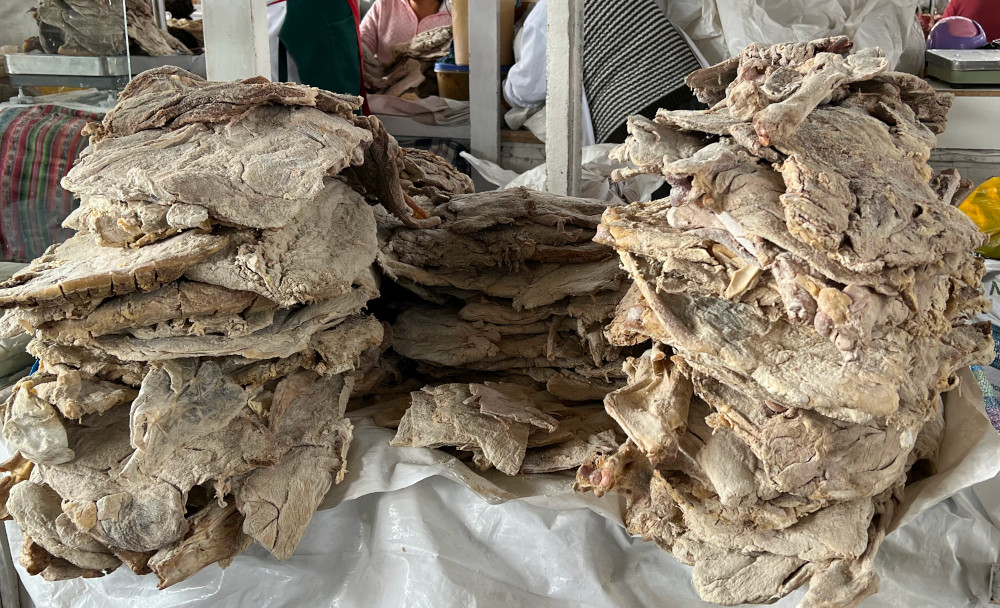
That gray stuff in the pic up above taken from the public market?  Julia and I speculated that it was some kind of weird seafood.  Nope, Freddy said, it's yerky.  Julia and I looked at each other before it clicked:  jerky.  In Peru, meat is heavily salted for preservation.  After it's salted and dried, and salted and dried, and salted and dried, that's what Peruvian jerky looks like.  It did not look like something that I wanted to put in my mouth.

During the first part of the tour, Freddy took us up into the hillside to the ruins near Cristo Blanco.  While we learned a lot about the Inca culture, Freddie was blunt about the fact that so much is still unknown.  The stones used to build the temples and government buildings were moved long distances and up steep mountainsides.  The Inca had no horses or oxen.  There were no steel tools for cutting or shaping stone.  

Experts today can only hypothesize how the materials for construction were transported and then used at the building sites.  And the hypotheses keep changing as more ruins are uncovered and analyzed. 


Sacrifice Altar for people and animals

Window to a window to a window

Why can't we look back at the Inca written history to answer some of these questions?  Because there isn't any.  The Inca depended upon an oral history.

When the Spanish arrived during the 1500's, they killed off all of the leaders and educated people among the Inca.  The Spanish also destroyed many temples.  As a result, their history was mostly lost.  The Spanish didn't care much about learning the Inca construction techniques, but they were seriously focused about learning where the hidden Inca gold was.  As it turns out, there is very little gold or silver in the Cusco area.  The precious metals mined from other places in Peru were carefully hidden away  in the jungle--and only the elite knew the hiding places. 

When the Spanish demanded to know where the gold was, the remaining Inca honestly answered that all of the people who had the answers were dead.  To this day, treasure hunters are still trying to find the Inca gold.

Until we talked to Freddy, we had admired dozens of large Spanish churches.  Freddy told us that the Spanish destroyed the Inca temples in Cusco,  and replaced them with Catholic churches on the same sites.  Somehow, the cathedrals didn't seem quite as beautiful with that knowledge.

Freddy left us around noon, letting us know for the first time that he would be our Inca Trail guide also.  We would meet that night with our fellow trekkers and for our orientation. 


Peruvian Dining

The place that we heard and read about was called Chicha.  One doesn't get a table for dinner there without reservations.   And there were simply no reservations available before our Inca Trail hike, unless we were willing to eat at 9:30 p.m.  I'm not one for eating a meal right before bedtime.

Instead, we ended up at a place called Morena Peruvian kitchen which overlooked the Plaza de Armas. Peru is well-known for delicious food, and this was probably the best dining experience that we've had in many years anywhere for less than the price of Olive Garden in the U.S.

It started with a Pisco Sour.  Pisco is a grape distilled spirit.  The cocktail is generally made with Pisco, lime juice, egg white, and bitters.  Mine had some other fresh juices in it and was made table-side--something new to me.


Julia and I shared an appetizer:  grilled alpaca on a skewer, along with  potatoes and vegetables.  Peru has over 200 varieties of potatoes. 

Yes, the flowers are edible

Julia had a non-alcoholic drink made from purple corn and a chicken dish.

I had what they called beef stir-fry, but that doesn't do it justice. The marinated beef was flavorful and so tender that you could cut it with a fork.


Next up:  our guided tour of Cusco's public market and historical sites.


Camping with Elon?

 This interesting rig was in our campground last night. The trailer appears to be a prototype from a California start-up company.